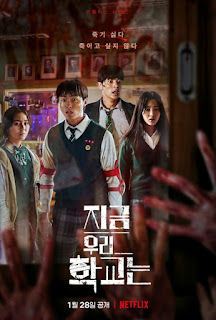
All of Us Are Dead; or, Too Cruel for School Listen carefully. You know how to play tag, right? We're all hiding here to get away from someone. But now... you're it. All of Us Are Dead is the latest South Korean zombie series which premiered on Netflix at the end of January, 2022. Based on a webtoon series created by Joo Dong Geun, the 12-episode drama delivers a high level of zombie insanity within the school setting. Yet, the viewing experience is not without flaws.
Release Info
Directed by: Lee Jae Gyoo, Kim Nam SuStarring: Park Ji Hoo, Yoon Chan Young, Jo Yi Hyun, Lomon
Language: KoreanOriginal Title: 지금 우리 학교는 No. of eps.: 12
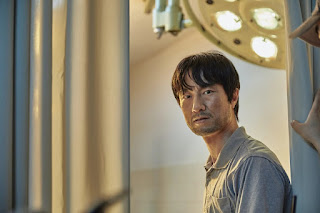
Synopsis A former worker of a pharmaceutical company, Lee Byeong Chan (Kim Byung Chul) currently works as a life science teacher at Hyosan High School. In order to protect his son, the scientist has developed a deadly virus which basically takes control over its host and amplifies primal instincts. In other words, those infected are driven by the sole will to survive. Unfortunately, one of the students gets bitten by Lee Byeong Chan’s lab rat. This turns the Hyosan High School into ground zero for a zombie virus outbreak. Students in distress will have to fight their way through in order to stay alive.
The School Job I have to say that I am fairly open to the zombie genre in general and I do not mind suspending my disbelief when clichéd situations kick in (*#Alive and Peninsula flashbacks*). However, All of us Are Dead, albeit extremely fast-paced and entertaining, did not click with me in a lot of places.
My major issue with this drama is its inconsequentiality. Zombie flicks are always driven by a set of specific rules and All of Us Are Dead is no exception from that. The problem arises when these rules are bent or done away with just to push the story further. For instance, the virus is transmitted by the act of an infected person biting a healthy person. It is said in the show that zombie transformation lasts approximately 10 minutes, but sometimes it is just 30 seconds and voilà! Some characters get to say a whole monologue in their last moments or they are able to sacrifice themselves in a glorious battle, others; unfortunately, catch one breath and become red-eyed monsters.
One more example (without giving away major spoilers): By logic, it is safe to assume that a character infected with a mutated strain of the virus would transmit that particular strain, but this does not always work out either. I understand that the screenwriters wanted to avoid getting cornered by these zombie rules, but some of these critical moments in the drama were so baffling that I was unable to suspend my disbelief. In addition, not giving the main heroes at least some nutrition plus water and expecting them to jump, kick, and fist fight all the time is unforgivable.
Still, there are many things I appreciate in All of Us Are Dead. The episodic form allowed to develop the mystery of the virus: what were its origins and how it mutated. This in turn had a great impact on the philosophical side of the story: nihilism vs. struggle to survive, school abuse vs. parental love, children distrusting adults, and the needs of the many vs. the needs of the few. All of it is present on the screen and it is awesome to see how these themes play out in the drama. What is more, All of Us Are Dead gives a thoughtful commentary on modern-day issues connected with the pandemic.
In terms of action, this show just does not let go. It takes many cues from Train to Busan (2016), and even references the movie, yet the drama does not go to extremes. That is to say, we will not see here zombies amassing on top of each other and creating huge living walls out of themselves. These zombies are more straightforward: they react to sound and relentlessly try to grab a bite.
With regard to heroes, there are so many of them that it is really hard to identify with and cheer for particular individuals. They just do not get fleshed out properly. Still, the main focus is on On Jo (Park Ji Hoo) and Cheong San (Yoon Chan Young). Personally, I think the love subplot works okay in the drama, but the characters which absolutely rock in this regard are Su Hyeok (Lomon) and Nam Ra (Jo Yi Hyun). Nam Ra in particular is awesome because of her story arc which is very similar to the trope of a misunderstood monster, like Frankenstein. Additionally, my fave characters are the supporting ones, like Ha Ri (Ha Seung Ri), Jun Sung (Yang Han Yeol), Mi Jin (Lee Eun Saem), and Min Jae (Jin Ho Eun) #ArcheryTeam4Life! I have also enjoyed a subplot centering on Eun Ji (Oh Hye Soo), but sadly it went completely nowhere.
As for the performances, the majority of young actors and actresses did awesome. I am sure that this drama will kick start acting careers for most of them. Park Ji Hoo obviously shines as she gets most of the screen time, but I also loved Jo Yi Hyun, Lim Jae Hyeok, Lee Eun Saem. They gave the most vibrant performances. With regard to veteran actors, Kim Byung Chul dominates the screen as the mad scientist, Jeon Bae Soo is heartbreaking as a father trying to save his daughter, whereas Bae Hae Seon delivers a reserved but memorable performance of a National Assembly Member. Forgive me if I have not mentioned your favourite artist, but the cast of this drama is so damn extensive!
Recommendations In spite of obvious, script-driven shortcomings, All of Us Are Dead is a generally pleasing thrill ride. I give it a strong 7/10 because of the action, amazing performances, and the final episode which wraps things up in a heart-warming way. Many viewers complain that the series ends with a cliff-hanger, but I dare to say that, to me, it is a complete ending but with a possibility of continuation woven into it. In view of the fact that the series had a strong opening on Netflix, I am positive that the announcement of a second season is only a matter of time. Thank you for reading. Stay safe and avoid these manic lab rats!
Overall score: 7/10
«Enjoyed this post? Never miss out on future posts by following us»
One Cut of the Dead; or, Don’t Stop the Camera! This is filmmaking! True filmmaking! Look! There's no fiction, no lies. This is reality! We keep rolling! The
late 2010s mark resurgence of the zombie genre. From Train to Busan
(2016) to #Alive (2020), Asian filmmakers continue to prove that still
new innovations can be implemented into formulaic movies about the
undead invaders. Undeniably, Shinichiro Ueda’s One Cut of the Dead (2017)
is also a part of this trend. To many overzealous horror fans out
there, this may be just a hilarious zombie comedy, but in my opinion,
this film is a heartwarming family drama about a father and his daughter
immersing themselves in a creative process.
Release Info
Directed by: Shinichiro UedaStarring: Takayuki Hamatsu, Harumi Syuhama, Mao
Language: JapaneseOriginal Title: カメラを止めるな! Runtime: 96 min
Synopsis Takayuki
Higurashi (Takayuki Hamatsu) is an experienced commercial director, but
he does not have groundbreaking projects on his record. He is approached
with an offer of making a live zombie film that will be used as a
launch feature for a TV horror channel. Takayuki assembles the cast and
crew, but he does not have much faith in the picture. While shooting at
an abandoned factory, it turns out that the real zombie apocalypse just
broke out. The cast and crew have to fight for their lives, whereas
Takayuki keeps on shooting in order to realise his masterpiece.
Zombie in the Box As
with the majority of my reviews, I also intend to keep this one
spoiler-free, so please take the synopsis above with a grain of salt. One
Cut of the Dead is so much more than just a tongue-in-cheek survival
flick with comedy elements. The first 36 minutes of the film is an
excellent parody of the genre, but also a brilliant showcase of
filmmaking technique. The entire first act was shot in one take!
Allegedly, the crew had to redo this sequence six times in order to get
it right.
After the outstanding introduction, the viewers are
presented with the lives of Takayuki and other crewmembers about a month
before the shooting. The second act actually blurs the lines between
reality and fiction. The “making” of One Cut of the Dead becomes a
meta-commentary on filmmaking, joining the line of such classic "movies
about movies" as Ed Wood (1994), Bowfinger (1999) and The Disaster Artist (2017).
The
motif which grabbed my heart the most was the one focusing on Takayuki
and his family. It is a joy watching their interactions and how they all
jump at the One Cut of the Dead project. This is where the third act
kicks in, which can be best described as a companion piece to Welcome
Back, Mr. McDonald (1997). In a way, both movies are about failed
productions which become masterpieces by pure coincidence.
One Cut of
the Dead was inspired by Ryoichi Wada’s stage play Ghost in the Box. I
tried to find more information about it, but only discovered that there
was a feud between Wada and director Shinichiro Ueda which was ultimately
settled by acknowledging Wada’s work in the end credits of One Cut of
the Dead. Interestingly, the production company, Enbu Seminar, also
organised special acting workshops for the cast which at that time was
largely inexperienced with the realm of film.
What is more, the
overwhelming success of One Cut of the Dead led to the release of
spin-off One Cut of the Dead Spin-Off: In Hollywood (2019), which
centers on Takayuki’s daughter, Hiromi (Mao), making her own film. The
year 2020 also saw the release of One Cut of the Dead Mission: Remote
which is a 37-minute-long special made to entertain the fans during
lockdown (the dance number is so adorable!). You can access the sequel
for free on YouTube.
Recommendations If you are on the lookout for
an unconventional flick that will keep you surprised and entertained,
then One Cut of the Dead is the choice for you. I got my DVD copy from Third Window Films. They offer the Blu-ray release of the movie as well.
Definitely worth checking out.
Overall score: 9/10
«Enjoyed this post? Never miss out on future posts by following us»
#Alive; or, An Ode to Self-isolation I should have gone shopping, just like you told me, mom! Korean cinema is on the roll with zombie movies. After Train to Busan movies and Kingdom drama, we now get #Alive, a survival thriller directed by Cho Il Hyung and starring Yoo Ah In and Park Shin Hye in the leading roles.
Release Info
Directed by: Cho Il HyungStarring: Yoo Ah In, Park Shin Hye
Language: KoreanOriginal Title: #살아있다 Runtime: 98 min
Synopsis Oh Joon Woo (Yoo Ah In) is a typical Korean gamer with high-tech stuff and too much time on his hands. He lives with his parents and sister. One day, he wakes up and finds a note left by his mother. When he turns on the TV, news anchors are talking about the outbreak of an unknown virus. All of a sudden, Oh Joon Woo’s apartment complex turns into chaos as other inhabitants transform into vicious monsters and start attacking each other. Stranded in an apartment, Oh Joon Woo gradually loses hope for rescue. Suddenly, he discovers that he is not the only survivor...
Running Out of Time I have heard about #Alive movie a couple of months ago, when reading the box office statistics from the Asian market. On top of that, many users on MDL eagerly shared their thoughts on the film. Needless to say, I had to check this one out, especially in view of the fact thatPeninsula (2020) came out just recently.
To be honest, I was surprised at how good this movie is. It starts in a low-key way, but the suspense build up just kept me glued to the TV screen. One could argue that zombie flicks are too clichéd and cheesy, but #Alive provides a much needed breath of fresh air, harking back to such classics about lone survivors as The Last Man on Earth (1964) and The Omega Man (1971).
All the more I cannot understand the bad rap this movie gets. People write in their reviews that it is boring, unrealistic, and too short. What? Have we seen the same movie? Of course, the beauty is in the eye of the beholder and I totally understand that people have their own preferences and attention spans, but the movie (with its clever screenplay and nicely done effects) certainly got my blood pumping.
The things I definitely have to praise are the following: great zombie design (way more vivid than in Train to Busan), catchy synthwave music score, out of the blue jump scares, and great performances of the main leads. Yoo Ah In and Park Shin Hye, who totally nailed it as people trying to escape from the zombie hellhole.
However, there were about two moments in the entire film which seemed a bit too hokey to me. Not getting into the spoilers area, allow me to say that at times the hero is protected by nothing more than plot armour. In my opinion, this is the only disadvantage of #Alive.
Recommendations If you like zombie horrors, and (most importantly), if you like Yoo Ah In, then I recommend the film. Watching it has been an invigorating experience. I strongly hope that director Cho Il-hyung and writer Matt Naylor will come up with more exciting stuff in the future.
Overall score: 8/10
«Enjoyed this post? Never miss out on future posts by following us»
Peninsula; or, Never Let Me Go Thirty-one cars… passed us by. I thought the first car would pick us up… but there were 30 more passing by. Peninsula is a sequel to the popular Korean zombie flick Train to Busan from 2016. While initially entitled Train to Busan 2: Peninsula, the first part of the title was quickly dropped and replaced with Train to Busan Presents. Indeed, Peninsula is a movie happening in the same universe as Train to Busan and Seoul Station (2016) anime, but with different characters and a brand new story. Let’s see how this new iteration of Koreans vs. bloodthirsty zombies holds up. Release Info
Directed by: Yeon Sang HoStarring: Gang Dong Won, Lee Jung Hyun, Lee Re, Lee Ye Won Language: Korean, EnglishOriginal Title: 반도 Runtime: 116 min
Synopsis Four years after the outbreak of a deadly virus on the Korean Peninsula, Han Jung Seok (Gang Dong Won), an ex-military officer lives as a refugee in Hong Kong. His brother-in-law, Goo Chul Min (Kim Do Yoon), cannot forgive Jung Seok that he didn’t try hard enough to save his wife and child. Due to their low-life status, the two men are recruited by mobsters and given the following assignment: go back to South Korea and retrieve a truck loaded with 20 million dollars. Upon arriving there, the mission is interrupted by dangerous scavengers who built a little world of their own in the zombie city. Jung Seok and Chul Min are separated. Jung Seok ends up being saved by a family of survivors unaffiliated with the scavengers. He remembers that they are the same people whom he refused to help four years earlier. Together with Min Jung (Lee Jung Hyun), the mother of the family, Jung Seok sneaks into the scavengers’ camp to retrieve a satellite phone. The only chance for rescue...
Here We Go Again I have to admit that I was a bit reluctant to check out Peninsula immediately after it premiered due to many unfavourable reviews which I read online. With incredibly low expectations, I finally watched the film and I was surprised that it is very much watchable.
Similarly to such films as Beneath the Planet of the Apes (1970) and Aliens (1986) (two sequels to classic masterpieces), the dangers and stakes are already established, so instead of rehashing them, the filmmakers should build on them. This is very much the case with Peninsula. We do not have yet another train survival story, but extensive world building. I liked the premise that those who managed to escape Korea are looked down by the rest of the world. Nevertheless, there are also people who were left behind and managed to stay alive. Even North Korea is referenced as the zombie-free place (obvious wink at one of the scenes from World War Z (2013)).
What I like the most about the film are the characters and their dynamics. Jung Seok is a decent guy struggling with traumatic past, Min Jung is a super cool protective mother saving the day, whereas the children Joon Yi and Yoo Jin (Lee Re and Lee Ye Won, respectively) and the grandpa (Kwon Hae Hyo) provide a much needed comic relief in tense situations. I particularly enjoyed the witty remarks of Ye Won’s character; this kid is gold!
With the bigger budget than the previous film, Peninsula also cranks up the action aspect to the maximum level. However, while watching hordes of zombies getting killed in many ways is certainly enjoyable, the film also goes a bit too far in a few places. The subplot about the scavengers living in a dilapidated city resembled too many popular post-apocalyptic flicks. At times, I was genuinely convinced that Peninsula is remaking chunks of Max Mad: Beyond Thunderdome (1985) and 28 Days Later (2002). In addition, the chase scene in the third act (lots of CGI) clearly drew inspiration fromFury Road (2015).
That being sad, Peninsula is not a bad film. I appreciated the pacing and also the significantly toned down melodrama (Train to Busan relied too much on harrowing moments). If you couldn’t come to terms with the ending of the first film, then the conclusion of Peninsula will certainly leave you satisfied.
With regard to performances, Lee Jung Hyun and Gang Dong Won certainly carry the weight of the picture. I remember Jung Hyun from Battleship Island (2017) and she is undeniably an awesome actress. As for Gang Dong Won, he obviously manned up after the last time I saw him in The Priests (2015). In addition, Lee Re and Lee Ye Won are wonderful as the children fighting the zombies.
At the end of this review, I think I should address the untimely coincidence that is repeated by other reviewers. That is to say, Peninsula is a movie (about a zombie virus) released in the year of the real global pandemic. Well, the movie is fiction and one should be able to differentiate it from real life. Peninsula was commissioned in 2018 and entered production in 2019, so it is not like director Yeon Sang Ho could see into the future and write a script based on the foreshadowings. If some people desperately want to see correlations between life and art, then I suggest watching Wolfgang Petersen’s Outbreak from 1995.
Recommendations All in all, Peninsula may not be as good as Train for Busan, but it is still worth watching. I do not regret spending two hours on this film. It was a joyous ride, even though it was a one time experience. To be honest, I’m now waiting for the fourth instalment of the zombie saga in which North Korea steps into action. Please Supreme Leader, greenlit this film!
Overall score: 7/10
«Enjoyed this post? Never miss out on future posts by following us»
Train to Busan; or, Shinkansen Daibakuha meets Zombie Apocalypse
Attention, everyone. For the safety of those on board we
won't be making any stops. We're heading straight for Busan.
It’s just a day like every other day. You wake up early in
the morning, travel by car (did fire-fighters’ trucks just pass you?), and
reach a railway station. You buy your ticket, take your seat and... relax?
Nope! Because a girl infected with a zombie virus just ran into the compartment.
Welcome on the Train to Busan! Release Info
Directed by: Yeon Sang HoStarring: Gong Yoo, Ma Dong Seok, Jung Yu Mi, Kim Su An
Language: KoreanOriginal Title: 부산행 Runtime: 118 min
Synopsis
Seok Woo (Gong Yoo) is an ever-busy fund manager from Seoul
who does not have the time for his daughter Soo An (Kim Su An). On the day of
her birthday, she pleads with the father to take her to Busan to see her
mother. Seok-woo reluctantly complies
and they depart on the KTX train the next morning. Nevertheless, it turns out
in the news that some kind of violent riots are breaking out across the
country. The truth about the impending zombie apocalypse is finally revealed when
one of the infected passengers transforms and proceeds to attack other people
on the train. Now, those who are still alive (Seok Woo and his daughter, Sang Hwa
(Ma Dong Seok) and his pregnant wife Seong Kyeong (Jung Yu Mi), a high school
baseball team, two elderly sisters, and a hobo) have to fight for their survival
until they reach Busan.
Get in or Die
First of all, I should point out that I’m not a huge fan of
zombie flicks. The Walking Dead series is something totally strange to me andthat stupefying Brad Pitt movie based on a great novel did not impress me. However, Train
to Busan pleasantly surprised me. It’s not a horror, but at the same time,
something more than just another zombie story. Specifically, it is a high-speed
action drama with neatly sketched out characters and a thrilling screenplay.
Though Train to Busan starts off as a typical Korean drama
(father and daughter issues), when the action kicks in, it kicks you right in
the guts, and it keeps kicking you until the closing credits roll. It would be a
gross indiscretion from my part to mention any spoilers, so I will just limit
myself to the following comment: The film successfully keeps your adrenaline
level up with lots of exciting sequences inside the train (the rescue mission
is icing on the cake!) as well as outside of it (the final act).
However, the movie is not just about making one’s way
through hurdles of the un-dead flesh-gourmets. It is also a subtle study case
of an epidemic (shared similarity with Contagion (2011)), a father-daughter
reconciliation set against the background of a raging pandemonium, and the
examination of the virtues of altruism (unintentional reference to Ayn Rand?).
All of the abovementioned features are what makes Train to
Busan such an exhilarating cinematic experience. Not forgetting about the cast,
Gong Yoo delivers another fine performance together with Jung Yu Mi (they
starred alongside together in The Crucible (2011)). Also, Kim Eui Sung as a
snobby executive who turns into a heartless, rotten-to-the-core, antagonist does a great job. Honourable mentions go to Ma Dong Seok as a straightforward
working-class husband and Kim Su An as Seok Woo’s daughter. Jang Young-Gyu’s
music score varies greatly across the film, yet works in every scene (though, I
don’t feel encouraged to listen to it independently).
Recommendations
I can safely recommend it to everyone. Train to Busan has
everything which a solid entertaining movie requires. It’s got the story,
disaster, human drama, vivid characters, and a train. In other words, it’s a
multi-layered entertainer which effortlessly excels in the genres of disaster
and zombie flicks. Train to Busan takes you on a wild ride, which can only be
equalled by the thrilling journeys of The Bullet Train (1975) and Runaway Train
(1985). This Korean hit has something for everybody and it’s definitely worth
checking it out on the big screen.