Showing posts with label thriller. Show all posts

Mad Cats (2023) [Film Review]

Mad Cats; or, Demon Warriors
     This has nothing to do with me! I just got dragged into it!
Welcome to another December review, in which I am taking a look at another upcoming Third Window release, which is Mad Cats (2023), an indie action flick cooked up by director Reiki Tsuno.
Release Info
Directed by: Reiki Tsuno Starring: Sho Mineo, Yuya Matsuura, Ayane
Language: Japanese, English Original Title: MAD CATS Runtime: 88 min
Synopsis
Taka (Sho Mineo) is a young guy who leads a “worthless” existence. One day, he receives a tape on which a female voice tells him that his brother (So Yamanaka), an archeologist, is held captive at a place where they once found a cat. Taka rushes to that place only to discover that there is an ancient artefact from Egypt, which is the forbidden catnip. Demonic cats who turned into humans are chasing after Taka. In the quest to save his brother, he is joined by a street beggar Takezo (Yuya Matsuura) and a mysterious woman (Ayane).
Hell Here
I have to say that I went in to check out Reiki Tsuno’s Mad Cats completely blind, having read completely nothing about the movie beforehand, and this approach was beneficial to me. Mad Cats feels like an homage not only to the pulpy style of Quentin Tarantino, but also to many horror/thriller flicks from the 1980s like The Terminator (1984) or Fright Night (1985).
In fact, I did notice the stylistic parallels between Mad Cats and Adam Wingard’s The Guest (2015) which also was constantly referring to the kick-ass cinema of the 1980s. Awesome soundtrack composed by Yuki Hotta (with the generous usage of Birthday Girl songs) and really eye-catching cinematography by Shintaro Teramoto are the definite assets of the movie.
That being said, the story itself may not be everybody’s cup of tea. Undoubtedly, Mad Cats has the necessary dosage of comedy, action, and typical sense of creative wackiness you would expect from an indie production, but at times, the film may feel dragged out and repetitive with some of its sequences.
This may also come off as nitpicking, but I do believe that sound mix might have been improved. Maybe it was only my case because I was watching the film with headphones, but a lot of sound effects seemed louder than the regular voice track. Still again, this is not a big issue that distracts you from the viewing experience.
With regard to performances, the main actors do a fine job. Sho Mineo is great as the goofy everyman, Ayane is definitely a force of nature as the female warrior, whereas Yuya Matsuura is having a field day as a street bum who accidentally gets entangled in an otherworldly battle. After seeing the actor in Onoda - 10,000 Nights in the Jungle (2021), and Lonely Glory (2022), I really look forward to his future projects.
Recommendations
All things considered, Mad Cats is an interesting indie production with a big heart, but there are certain loose ends which may be noticeable for demanding viewers. Personally, I do not regret seeing it. The movie is going to be made available on region-free Blu-Ray from Third Window Films on the 29th of January, 2024. The release is going to include such bonus features as an interview with director Reiki Tsuno, director feature commentary, behind the scenes materials, and theatrical trailer.
Overall score: 6/10
«Enjoyed this post? Never miss out on future posts by following us»

A Night in Nude (1993) [Film Review]

A Night in Nude; or, Life on Lease
      Whatever it is, we do it for you, so you don’t have to do it.
The late Takashi Ishii is one of the few Japanese directors that never won me over, mainly because of the fact that the genre he specialises in was never right up my alley. Erotic crime thrillers and straight up exploitation flicks are just too much for me, but I decided to give the director a chance when I found out about A Night in Nude, starring one of my fave veteran actors out there: Naoto Takenaka.
Release Info
Directed by: Takashi Ishii Starring: Naoto Takenaka, Kimiko Yo, Kippei Shiina
Language: Japanese Original Title: ヌードの夜 Runtime: 110 min
Synopsis
Jiro (Naoto Takenaka) is a guy for hire. He basically serves as a stand-in at events which nobody wants to attend, but he will do any kind of job for money. One day, his agency is visited by a woman called Nami Tsuchiya (Kimiko Yo). She hires Jiro to be her tour guide in Tokyo. The next day, Jiro receives a phone call instructing him to visit Nami’s room in a hotel and clean it up. When Jiro arrives, he discovers that there is a dead body in a bathtub…
The Days of Being Prosperous
A Night in Nude is, thankfully, more of a crime flick than pinku production; however, it does contain a fair share of NSFW sequences, especially in the third act. On the whole, the movie feels very neo-noir with its dense atmosphere, night scenes, and just breathtaking cinematography that captured the image of post-Bubble Japan. You could literally frame all the master shots from the film and hang them on your wall.
Come to think of it, the story of A Night in Nude is a social commentary on the situation of Japan in the 1990s. Jiro is a man without a purpose who lives in a country that desperately wants to keep up appearances of glamour and lavish lifestyle, but the whole thing is an illusion because they are living on a lease, borrowing stuff rather than paying for it.
This is very much the case with femme fatale of the picture, Nami, who desperately tries to breakaway from the roots in poverty and criminal underworld to finally become a respectable member of the fake society. However, what she does in order to fulfil her dream only consumes her morality, in a very Dostoevsky-like manner.
With regard to performances, it is a weird experience for me watching young Naoto Takenaka in action, but he effortlessly portrays a sympathetic guy who is knee-deep in an affair that is beyond his professional expertise. Kimiko Yo is absolutely outstanding in the role of a tragic woman who commits a crime. It is a real shame that this actress gets mainly supporting roles nowadays. Kippei Shiina is, unfortunately, unconvincing as a homosexual yakuza sidekick. Jinpachi Nezu is okay as the villain of the picture, but his screen time is limited.
Recommendations
All things considered, I do not regret watching this film. It was an interesting experience indeed, but I think the movie would have been better had the last 20 minutes got cut. Sadly, this final section of the film only washes over a satisfying resolution and provides only the shock value. Then again, cinematography in the film is just beautiful. Interestingly, Ishii made a sequel to this film 17 years later called A Night in Nude: Salvation (2010). So I may give it a try, just to see my boy Naoto Takenaka in noir action again.
Overall score: 7/10
«Enjoyed this post? Never miss out on future posts by following us»

Audition (1999) [Film Review]

Audition; or, Love, Unconditionally
     Only pain and suffering will make you realise who you are.
Takashi Miike’s Audition is one of those rare J-Horror films which I never thought would be discussed on this blog. As some of the readers already know, I am not a fan of the horror genre in general, but I decided to give this film a chance in view of my recent reinvigoration of interest in the works of Ryu Murakami. In view of the fact that Audition remains to date the most popular adaptation of Murakami’s famous novel, I finally caved in and I am sharing my thoughts on it.
Release Info
Directed by: Takashi Miike Starring: Ryo Ishibashi, Eihi Shiina, Jun Kunimura
Language: Japanese Original Title: オーディション Runtime: 115 min
Synopsis
Shigeharu Aoyama (Ryo Ishibashi) is a TV producer who lost his wife seven years ago. His teenage son encourages Aoyama to get married again. The problem is that Aoyama has trouble finding the new other half. His colleague at work comes up with an idea to set up an audition call for a new movie. Out of the many women who compete to get the leading role, Aoyama choses a lady whom he finds the most intriguing, Asami Yamazaki (Eihi Shiina).
Too Many Secrets
Like Hideo Nakata’s Ring (1998) or Kinji Fukasaku’s Battle Royale (2000), Audition is yet another classic instance of Japanese Horror that is continuously talked about and discussed among the academics. Personally, I regard this movie not so much as a horror (albeit it has a substantial amount of explicit content), but as a psychological thriller that throws shade at romance movies.
If anything, the first half of Audition feels like a parody of popular rom-coms penned by Richard Curtis. Such types of shugary sweet storylines about an honest guy and a fair lady finding true love through comedy-charged shenanigans only condition the viewers to repeat such patterns in real life, but the truth is that these do not work at all. In the case of Audition, they do not work either because the movie is not about happy-go-lucky cheerfulness, but about suffering: how traumatic events mess up our personalities.
Director Takashi Miike and cinematographer Hideo Yamamoto really brought to life this claustrophobic feeling of nihilism tainted by nostalgia for the Showa era that accompanies Ryu Murakami’s novels. Warm lighting in indoor locations and especially the usage of red colour really enhance the aspect of Aoyama’s depravation (the whole audition gig), but also of his victimhood whenever he interacts with Asami.
I apologise because I can’t help but cross over into the territory of deconstructing the film, but allow me to say that I regard the third act as pretty clear and straightforward. Asami was the childhood victim of her relatives, which subsequently turned her into a monster. Aoyama, on the other hand, never quite knew what he wanted as a man because he was essentially woman-less for a long time. The whole torture sequence is, in my opinion, Miike’s manifesto against pornography. What leads me to such an assumption are the positions of the characters in the scene, and specific POV shots that are very reminiscent of JAV productions. In consequence, what seems to be every man’s dream (being overpowered by a beautiful woman) turns out to be Aoyama’s worst nightmare.
With regard to performances, Ryo Ishibashi gives a compelling and sincere portrayal of Aoyama. I mainly know the actor from dramas, but he really carried the picture with his performance. As for Eihi Shiina as Asami, she was truly menacing as the love interest. The legendary Jun Kunimura deserves a mention because he plays a supporting role of a good guy in the film, and his character actually does not get killed off for a change.
Recommendations
All things considered, Audition is not a movie for the faint-hearted, but if you enjoy the filmography of Takashi Miike, the J-Horror genre in general, or at the very least the bizarre mind of Ryu Murakami, then you should watch this film. Where I live, it was issued on DVD by GutekFilm distribution label.
Overall score: 7/10
«Enjoyed this post? Never miss out on future posts by following us»

300th Review: A Tale of Two Sisters (2003)

A Tale of Two Sisters; or, Rose Flower, Red Lotus
     As much as you hate It, I'm the only one in this world you can call mother, got it?
One of my recent visits at a thrift store resulted in obtaining a DVD release of Kim Jee Woon’s A Tale of Two Sisters. Actually, I remember reading about this particular horror film during seminar classes at my university, where a lecturer did a comparison between this film and its Hollywood remake: The Uninvited. So, needless to say, let’s discuss the movie in detail.
Release Info
Directed by: Kim Jee Woon Starring: Im Soo Jung, Moon Geun Young, Yum Jung Ah
Language: Korean Original Title: 장화, 홍련  Runtime:115 min
Synopsis
A teenage girl called Su Mi (Im Soo Jung) was being treated for psychosis in a mental institution. After being discharged, she returns home with her father (Kim Kap Soo), and younger sister Su Yeon (Moon Geun Young). The two sisters have a strong bond and always support each other. However, they refuse to acknowledge Eun Joo (Yum Jung Ah) as their step-mother, which causes friction among family members. Soon after, Su Mi and Su Yeon start seeing supernatural phenomena around the house, even witnessing the ghost of their late mother (Park Mi Hyun).
Past Trauma
I think it is safe to say that Kim Jee Woon is a jack of all trades when it comes to delivering a variety of different genres, from a wacky comedy to an exciting thriller. Evidently, A Tale of Two Sisters is no exception. Having been inspired by a folktale story Janghwa Hongryeon jeon, Kim Jee Woon crafts a dark, slow-paced horror with psychological undertones taken verbatim from the pictures of Kiyoshi Kurosawa.
At its core, A Tale of Two Sisters is the story about the breakdown of a nuclear family. Of course, there are many unexpected plot twists along the way, sprinkled with supernatural elements and jumpscares. Yet, the dramatic reveal in the film’s finale essentially brings the whole thing down to a conflict between a girl and a step-mother, which was set in motion by an ignorant father.
I am not a big fan of a disjointed style of narrative, but in the case of A Tale of Two Sisters, it actually works. There are many sequences throughout the film which make you think whether what you are seeing is real or unreal. In particular, I refer to a chilling scene in which the character of Eun Joo looks for the mother’s ghost under a sink.
With regard to performances, Im Soo Jung and Moon Geun Young did a great job as sisters caught up in a Shakespearean-like tragedy. Nevertheless, they can’t hold a candle to Yum Jung Ah as the devilish step-mom. She really ascended to the heights of Disney villainy in this movie. Kim Kap Soo does well as the emotionless and out-of-touch father.
Recommendations

All things considered, if you want to keep yourselves engaged and put together pieces of a fragmented mystery for two hours, then I recommend A Tale of Two Sisters. To me, it was definitely a more compelling film than The Uninvited remake. The DVD edition I have was issued by IDG company in 2007. Unfortunately, it has no bonus features, but there is a DTS audio track, which improves the viewing experience. Internationally, the film was also issued by Tartan Films in 2005 and by Arrow Video in 2021.
Overall score: 8/10
«Enjoyed this post? Never miss out on future posts by following us»

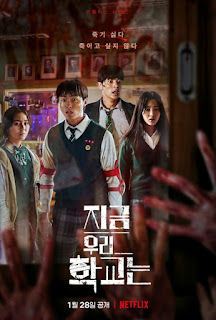
All of Us Are Dead (2022) [Drama Review]

All of Us Are Dead; or, Too Cruel for School
     Listen carefully. You know how to play tag, right? We're all hiding here to get away from someone. But now... you're it.
All of Us Are Dead is the latest South Korean zombie series which premiered on Netflix at the end of January, 2022. Based on a webtoon series created by Joo Dong Geun, the 12-episode drama delivers a high level of zombie insanity within the school setting. Yet, the viewing experience is not without flaws.
Release Info
Directed by: Lee Jae Gyoo, Kim Nam Su Starring: Park Ji Hoo, Yoon Chan Young, Jo Yi Hyun, Lomon
Language: Korean Original Title: 지금 우리 학교는 No. of eps.: 12
Synopsis

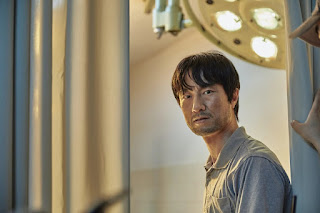
A former worker of a pharmaceutical company, Lee Byeong Chan (Kim Byung Chul) currently works as a life science teacher at Hyosan High School. In order to protect his son, the scientist has developed a deadly virus which basically takes control over its host and amplifies primal instincts. In other words, those infected are driven by the sole will to survive. Unfortunately, one of the students gets bitten by Lee Byeong Chan’s lab rat. This turns the Hyosan High School into ground zero for a zombie virus outbreak. Students in distress will have to fight their way through in order to stay alive.
The School Job
I have to say that I am fairly open to the zombie genre in general and I do not mind suspending my disbelief when clichéd situations kick in (*#Alive and Peninsula flashbacks*). However, All of us Are Dead, albeit extremely fast-paced and entertaining, did not click with me in a lot of places.
My major issue with this drama is its inconsequentiality. Zombie flicks are always driven by a set of specific rules and All of Us Are Dead is no exception from that. The problem arises when these rules are bent or done away with just to push the story further. For instance, the virus is transmitted by the act of an infected person biting a healthy person. It is said in the show that zombie transformation lasts approximately 10 minutes, but sometimes it is just 30 seconds and voilà! Some characters get to say a whole monologue in their last moments or they are able to sacrifice themselves in a glorious battle, others; unfortunately, catch one breath and become red-eyed monsters.
One more example (without giving away major spoilers): By logic, it is safe to assume that a character infected with a mutated strain of the virus would transmit that particular strain, but this does not always work out either. I understand that the screenwriters wanted to avoid getting cornered by these zombie rules, but some of these critical moments in the drama were so baffling that I was unable to suspend my disbelief. In addition, not giving the main heroes at least some nutrition plus water and expecting them to jump, kick, and fist fight all the time is unforgivable.
Still, there are many things I appreciate in All of Us Are Dead. The episodic form allowed to develop the mystery of the virus: what were its origins and how it mutated. This in turn had a great impact on the philosophical side of the story: nihilism vs. struggle to survive, school abuse vs. parental love, children distrusting adults, and the needs of the many vs. the needs of the few. All of it is present on the screen and it is awesome to see how these themes play out in the drama. What is more, All of Us Are Dead gives a thoughtful commentary on modern-day issues connected with the pandemic.
In terms of action, this show just does not let go. It takes many cues from Train to Busan (2016), and even references the movie, yet the drama does not go to extremes. That is to say, we will not see here zombies amassing on top of each other and creating huge living walls out of themselves. These zombies are more straightforward: they react to sound and relentlessly try to grab a bite.
With regard to heroes, there are so many of them that it is really hard to identify with and cheer for particular individuals. They just do not get fleshed out properly. Still, the main focus is on On Jo (Park Ji Hoo) and Cheong San (Yoon Chan Young). Personally, I think the love subplot works okay in the drama, but the characters which absolutely rock in this regard are Su Hyeok (Lomon) and Nam Ra (Jo Yi Hyun). Nam Ra in particular is awesome because of her story arc which is very similar to the trope of a misunderstood monster, like Frankenstein. Additionally, my fave characters are the supporting ones, like Ha Ri (Ha Seung Ri), Jun Sung (Yang Han Yeol), Mi Jin (Lee Eun Saem), and Min Jae (Jin Ho Eun) #ArcheryTeam4Life! I have also enjoyed a subplot centering on Eun Ji (Oh Hye Soo), but sadly it went completely nowhere.
As for the performances, the majority of young actors and actresses did awesome. I am sure that this drama will kick start acting careers for most of them. Park Ji Hoo obviously shines as she gets most of the screen time, but I also loved Jo Yi Hyun, Lim Jae Hyeok, Lee Eun Saem. They gave the most vibrant performances. With regard to veteran actors, Kim Byung Chul dominates the screen as the mad scientist, Jeon Bae Soo is heartbreaking as a father trying to save his daughter, whereas Bae Hae Seon delivers a reserved but memorable performance of a National Assembly Member. Forgive me if I have not mentioned your favourite artist, but the cast of this drama is so damn extensive!
Recommendations
In spite of obvious, script-driven shortcomings, All of Us Are Dead is a generally pleasing thrill ride. I give it a strong 7/10 because of the action, amazing performances, and the final episode which wraps things up in a heart-warming way. Many viewers complain that the series ends with a cliff-hanger, but I dare to say that, to me, it is a complete ending but with a possibility of continuation woven into it. In view of the fact that the series had a strong opening on Netflix, I am positive that the announcement of a second season is only a matter of time. Thank you for reading. Stay safe and avoid these manic lab rats!
Overall score: 7/10
«Enjoyed this post? Never miss out on future posts by following us»

The Silent Sea (2021) [Drama Review]

The Silent Sea; or, 2021: A Lunar Odyssey
     Not a damn thing works smoothly in this station.
I have been looking forward to The Silent Sea drama since the first information about the shooting schedule dropped in December, 2020. Still, I had to endure an additional month of waiting after the Netflix premiere at the end of 2021 because of personal stuff and work. Well, as they say, better late than never. This is my review of The Silent Sea.
Release Info
Directed by: Choi Hang Yong Starring: Gong Yoo, Bae Doona, Lee Joon, Kim Sun Young
Language: Korean Original Title: 고요의 바다 No. of eps.: 8
Synopsis

Near future, the world is plagued by shortages of water and food caused by environmental changes. Doctor Song Ji An (Bae Doona) can’t get over the death of her sister who tragically died in a mysterious accident on Balhae Base research station on the moon. The Republic of Korea’s Space and Aeronautics Division asks her to join a team of specialists led by Captain Han Yoon Jae (Gong Yoo). They are sent on a mission to retrieve top-secret samples from the now-abandoned Balhae Base. Upon arriving there, the team realises something is amiss. That is to say, something, or someone, is lurking within the premises of the base.
Fly Me to the Moon
The Silent Sea was based on a 2014 short film The Sea of Tranquillity (I couldn’t track it down) by Choi Hang Yong, who also directed all 8 episodes of the drama. Interestingly, the executive producer of the show was Jung Woo Sung, the star of Steel Rain (2017) and The King (2017). The screenwriting duties were given to Park Eun Kyo who penned in the past Neverending Story (2012) as well as Mother (2009).
This drama is science-fiction at its purest. Fans of the genre will undoubtedly notice that The Silent Sea borrows tropes and concepts left and right from such legendary juggernauts of modern cinema as the Alien franchise (1979-1997), The Abyss (1989), Leviathan (1989), and Ad Astra (2019). There is room for thoughtful critique of modern problems plaguing the social order, but this aspect does not eclipse the willingness of filmmakers to provide the audience with a dose of thrills and chills.
In my opinion, The Silent Sea feels very much like the Lost (2004-2010) TV series, but instead of the island setting we get the moon. The first episode of the drama, albeit visually outstanding, is a bit overwhelming because its main focus is setting up the action and introducing (lots of) characters. Onwards the second episode, it gets easier to dive into the mysteries concerning the Balhae Base as well as the motivations of the main protagonists: Captain Han Yoon Jae and Doctor Song Ji An.
I have read online a lot of criticism about the plotline of the drama, especially the climax and dramatic reveal of (no spoilers) what actually was going on, but I personally found the whole thing enjoyable. I especially appreciated the themes of political corruption, company wars, and unethical research. The only thing that put me off; however, were CGI effects concerning one of the characters. From the visual standpoint, the effects looked good, but there was still some degree of uncanny valley which made these sequences look awkward.
Still, I love the marvellous production design. The Balhae Base looks incredible and the moon’s surface is fantastic, whereas the space suits are awesome. With regard to performances, it is always a pleasure to see Gong Yoo in the heroic role. This time, there is an added bonus because Gong’s character has an epic tattoo on his neck. Bae Doona is always wonderful as the female lead, but I was hoping for more character development in this case. Throughout most of the drama, we see Doctor Song either as bitter or depressed.
As for the supporting cast, I absolutely love Kim Sun Young as Doctor Hong. I have said this already on MDL and I will say it again: To me, she IS the Space Ajumma! In addition, I greatly enjoyed the appearances of Lee Moo Saeng as Chief Gong, head of the security team, and of Lee Joon as Lieutenant Ryoo Tae Seok, the head engineer. In general, the cast members have great chemistry, which also transpires in these sweet promo materials from Netflix, here and here.
Recommendations
After Space Sweepers (2021) and now The Silent Sea, South Korea has proven once again that they can do top-notch entertainment, even in the form of a miniseries. I sincerely hope that there will be a second season; however, we have to bear in mind that the drama came out in-between two other major Netflix players: Squid Game (2021) and All of Us Are Dead (2022). It’s reassuring to see that Netflix cares about the K-Drama audience, but I hope the quality will not be overshadowed by the quantity. The Silent Sea deserves an additional season because there is still the potential to develop the story further, but I would not like to see this drama last as long as Lost, The Walking Dead, or Stranger Things. Sometimes shorter is better.
Overall score: 8/10
«Enjoyed this post? Never miss out on future posts by following us»

Cure (1997) [Film Review]

Cure; or, The Ultimate Treatment
     Doctor, can I tell you something? All the things that used to be inside me… now they’re all outside. So, I can see all of the things inside of you, Doctor. But the inside of me is empty.
When thinking about the revival of the J-Horror genre, people often mention such movies as Ring (1998), Audition (1999), and Battle Royale (2000) as responsible for reigniting the interest in scary tales made in Japan. However, I believe that Kiyoshi Kurosawa should not be excluded from receiving the credit. Apart from giving us a ghostly Pulse (2001), he also directed a mystery horror called Cure (1997) with Koji Yakusho in the leading role.
Release Info
Directed by: Kiyoshi Kurosawa Starring: Koji Yakusho, Masato Higawara, Anne Nakagawa
Language: Japanese Original Title: キュア Runtime: 111 min
Synopsis
Detective Takabe (Koji Yaskusho) is investigating a series of strange murders. The culprits are caught after the act and they claim not to know what pushed them to kill a person that was close to them. Every case has one thing in common, the victims died from blood loss resulting from a wound made in the shape of X mark. Suddenly, the police detain a man called Mamiya (Masato Hagiwara) who suffers from memory loss. Takabe is convinced that Mamiya is responsible for the killings because he possesses an extraordinary hypnotic power...
The Beast Within
I have seen Cure while I was on my binge trip through the hallmarks of Japanese Cinema a few good years ago. I went in completely cold without having read anything about the storyline, and I was absolutely amazed by how gripping Kiyoshi Kurosawa’s picture actually is.
First of all, the screenplay is fantastic. From the first few scenes you think that the film is going to play out like an ordinary police procedural, but all of a sudden, things make a U-turn, and we get a morbid tale as if cooked up by Stephen King himself. After the movie ends, you just can’t help but think about all the plot twists! The whole affair is told in a slow, sparing manner, so the viewer really needs to bring all the pieces together.
The cinematography is another interesting aspect. Most of the shots are very static and encompass more than one character in a frame. It reminded me greatly about Memories of Murder (2003) and, after doing some reading, I was surprised to discover that director Boon Joon Ho cites Cure (1997) as one of major inspirations that made him pursue filmmaking.
What is more, I like that Kurosawa does not rely in his movies on overt gore or jumpscares. The unsettling feeling of Cure lies within its mood and themes. The movie provides a brilliant mix of psychoanalysis and hypnosis grounded very neatly within the Japanese convention. In a society that thrives on hierarchy and team work, it is disheartening to see the main protagonist looking after his mentally-ill wife.
With regard to performances, Koji Yakusho evidently dominates the screen with his presence of a righteous cop, but Masato Higawara as the illusive Mamiya is just as awesome. The late Anne Nakagawa is also memorable as Takabe’s wife. I also give a shout out to Tsuyoshi Ujiki as Sakuma, the psychiatrist. His character may be there for exposition purposes only, but he also has a super crazy dream sequence.
Recommendations
If you are in the mood for a psychological examination of the Japanese collective psyche, then I recommend Kiyoshi Kurosawa’s Cure. Three years ago, the movie was released in Europe on DVD as well as Blu-Ray. When it comes to deep dives into the dark corners of the subconscious, then Cure will not let you down.
Overall score: 9/10
«Enjoyed this post? Never miss out on future posts by following us»