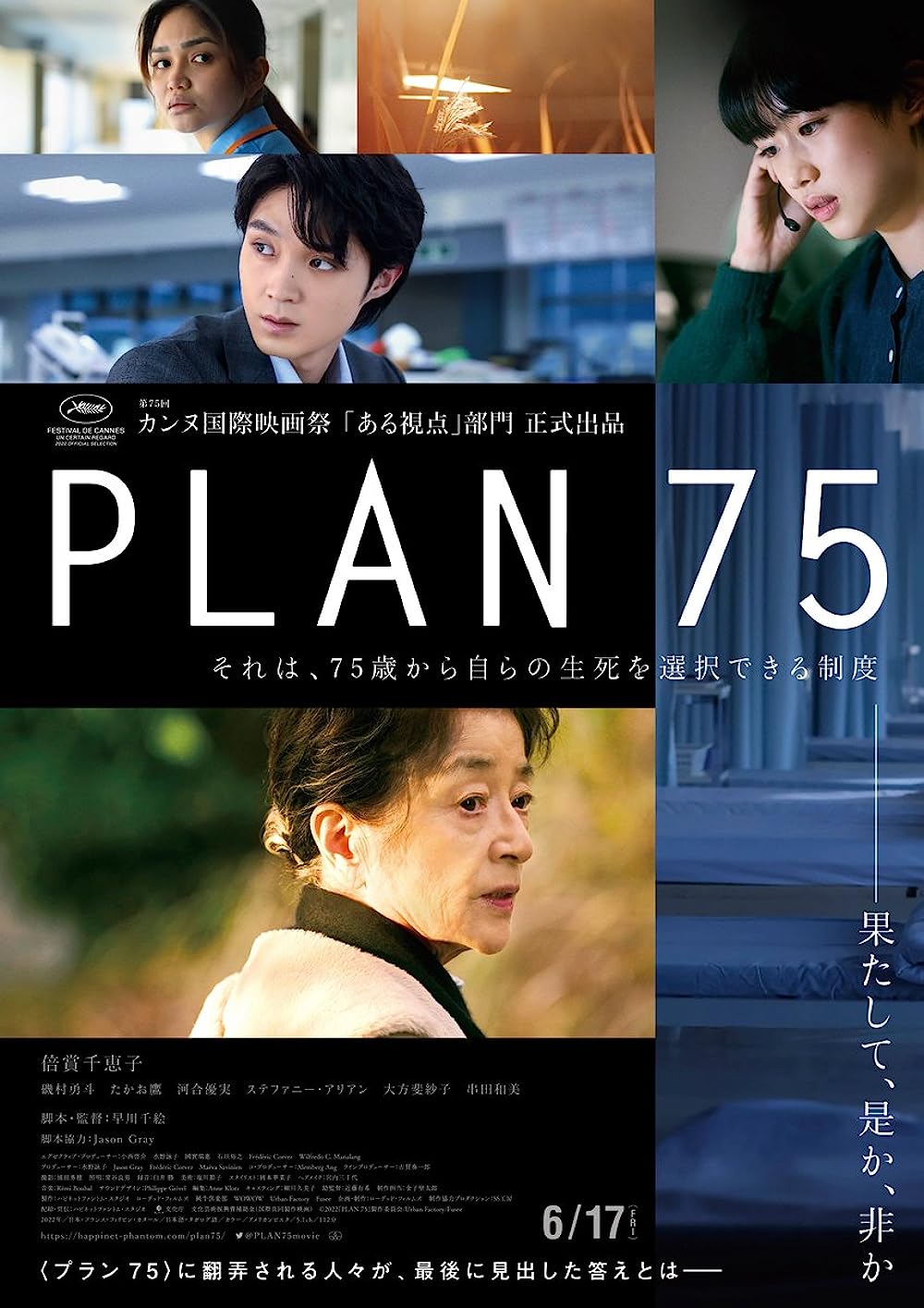
Plan 75 (2022) [Film Review]

Plan 75; or, The Death of Society
     It’s something I should think about doing for my grandchildren.
Plan 75 is one of those films that I really wanted to watch as soon as the official trailer dropped online. However, I was afraid that I won’t have the ability to do so because Chie Hayakawa’s movie is kind of a low-profile production that started to slowly gain traction through film festivals. Thankfully, I watched Plan 75 on the big screen in my own country because a local distributor picked up the rights for the film.
Release Info
Directed by: Chie Hayakawa Starring: Chieko Baisho, Hayato Isomura, Stefanie Arianne
Language: Japanese Original Title: PLAN 75 Runtime: 113 min
Synopsis
In view of the surplus of the elderly population, which has a negative influence on the economy of Japan, the government implemented a special bill called “Plan 75”. It enables voluntary suicide for citizens aged 75 and over. We follow the development of the plan through the perspectives of three people: Mishi Kakutani (Chieko Baisho), an elderly hotel worker who loses her job; Himoru Okabe (Hayato Isomura), an administrative worker who promotes the plan; and Maria (Stefanie Arianne), a staff member at a facility where the suicides are carried out.
The Gift of Life
Well, if you suffer from Thanatophobia or you can’t stand the topic of death, then Plan 75 is not a movie for you. This is not to say, however, that the movie is some kind of a dark thriller or horror. On the contrary, the power of Plan 75 stems from a mundane approach to the subject matter. It is not an apocalypse, not a war against humanity. The Japanese society accepts the outrageous political plan because herd mentality always wins against individual thinking. In fact, the individual has to conform and sacrifice himself or herself for the good of the group.
The more I think about the film, the more I find it disturbing. Chie Hayakawa insightfully examines the aforementioned dilemma through the main characters of the unfolding drama. The director shows that not only the elderly citizens are the victims of the situation, but also the younger generations who are taught fake empathy when interacting with prospective participants of Plan 75.
With regard to performances, allow me to say that being able to see the legendary Cheiko Baisho on the big screen, in a near-empty theatre room, was a profound experience for me. She really carried the film with her performance and I can’t imagine any other classic Japanese actress in the role of a woman who does not give up on hope. Hayato Isomura and Stefanie Arianne really shine in the supporting roles and the subplots of their characters really complement the main message of the film. Yuumi Kawai also appears as Yoko, a phone guide of Baisho’s character, but her screen time is limited to barely two scenes.
Recommendations
If you have the ability to watch the film legally where you live, then I encourage you to check out Plan 75. It was distributed in Poland by Aurora Films. I sincerely hope that the film will also receive a release on physical media outside of Japan.
Overall score: 8/10
«Enjoyed this post? Never miss out on future posts by following us»

It’s Tough Being a Blog Writer Part 2: Critical Boogaloo [Editorial]

Well, here it is. Nobody wanted it, and I didn’t plan on writing this post at all, but this is the second part of my original ramble which was posted a little over three months ago. This “sequel” of sorts came about in the light of my recent observations as well as encouragement from Rhythm Zaveri, a member of the admin panel of the Asian Cinema Enthusiastic group and a true passionate of Asian movies (you can check out the abundance of his reviews right here). Originally, I wanted to make this post directly on the facebook group, but I thought it would be too general in view of the guidelines, so I am sharing this text on the blog.
     Contrary to the first part of my editorial, where I talked about the challenges of writing, I would like to focus in the herein piece on the follies of film criticism. It all stemmed from a loose conversation I had at work when I was chatting with a fellow teacher and the conversation turned to foreign languages. She said that in order to use the foreign language one has to continuously repeat the grammar and vocab over and over again, so as not to forget all that jazz. I disagreed and replied that the usage of foreign language is not about mindless repetition, but active practice. Then, I provided the example of my blog which I run in English, even though I am not a native speaker of that language. However, writing in English allows me to actively engage with the language on a nearly daily basis.
     The fellow teacher nodded trying to process what I said to her and all of a sudden blurted out, “You write reviews, so you’re like a movie critic, right?”
     I know she did not mean anything negative with that kind of question, but at that moment I really felt as if I got thrown under a speeding bus. I politely explained that I am more of a movie enthusiast than a professional critic, and ended the conversation on that note. Looking back at that chat in retrospect, it was not the implication in that inquiry that hurt me, but my own perception of the matter because I absolutely do not regard myself as a film critic.
     What does it mean to be a film critic, anyway? We live in the times when film criticism is already a branch of academia with its rich toolkit of deconstructive approaches (formalism, structuralism, psychoanalysis, etc.). Back in the old days, in the era of VHS, I was under the impression that a film critic is basically a journalist who works for a magazine, writes reviews, and even provides a recommendation tagline that is used on the front cover of a film. In fact, this is how the job originated in the United States, but throughout the decades it has gained a more refined connotation. The conventional critic stopped perceiving himself (or herself) as an ordinary writer and transformed into a self-proclaimed voice that defines the cultural taste of the masses. In my opinion, this transformation took centerstage in the 1990s with the increasing availability of movie magazines outside of the United States and the advent of special talk shows featuring either movie experts (see Alex Cox) or movie critics (see Roger Ebert and Gene Siskel).
     It was not until the digital age, however, that the profession really underwent a change. Field-specific websites and YouTube pushed out traditional media and really opened the way for amateurs to play up the great critical game. Arguably, the best examples illustrating this are personas of the Nostalgia Critic and Angry Video Game Nerd who in the mid 2000s found their niche by means of making funny, satirical, out-of-the box reviews. Nevertheless, there are still people out there who never caught the entertainment bug like the aforementioned Youtubers, and strive to be regarded as traditional film critics. Nevertheless, what is the cost of attaining this mythical seal of recognition that is so precious to them?
     If you want to become a professional film critic, you need to be well-versed in film studies and film history in general. You need to go deeper, beyond the iceberg of Julia Kristeva’s intertextuality, straight down the rabbit hole of the language of film. It is a very hard thing to do but not impossible. Most importantly, the real film critic is not a nitpicker, but a person who tries to view the film objectively as a work of art in spite of the fact that the very act of providing your opinion is subjective indeed. The best examples of film critics in my book who fulfil the abovementioned criteria are Mark Kermode, Tomasz Raczek, and Peter Travers.
 
    Still, there are some people out there (some but not many) who wish to cut corners and become critics without having necessary knowledge. I have met a few such individuals in my life, and the golden rule they follow is to latch onto either a group of people with necessary expertise (professional website) or a special event that gives them access to the high entertainment world (for instance, film festivals).
     Such an individual followed me out of the blue on social media some time ago. I just shook my head in pity and made a look like The Third World Skeptical Kid when I flicked through that person’s profile. The person in question is roughly the same age as I am, got their PhD in culture studies (mine was in literary studies), appeared on a podcast (same as me), runs a SNS page with reviews (I run my blog), but he desperately stylises himself to be a film critic by advertising himself as team member of a festival event and by writing pompous, and slightly pretentious stuff on Asian movies.
     Well, if you seek validation on social media in such a way, then it is not my business to interfere. The bottomline I am getting at with this editorial is as follows: there is a fine line of difference between a film critic and a film enthusiast, at least in my opinion. I consider myself to be a member of the latter category. I just run my blog and share my loose thoughts on film with you all. I may get intertextual at times, I may provide my personal analysis of a given film, but I never regard my opinions as definite, spellbinding, or setting the trends. I will never dare to cross over into the former domain because it is a real job, a real craftsmanship, and a real responsibility in front of many people. Unfortunately, some are unaware of this.
     All in all, If I ever happen to write pieces like “Traces of Loneliness and Phallocentrism in the Films of Wong Kar Wai” or “Oppression of the Nationalist Patriarchy in Hiroshi Shimizu’s Japanese Girls at the Harbor (1933),” the please do know that I have completely lost my grip on reality upon publishing these. Still again, if the titles I came up with inspired you, then you have my blessing to write these academic essays (if you haven’t done so already).
     I hope that I managed to get my message across. If not, then I invite you to read the conclusion of the first past of my editorial which gives you the whole thing in a nutshell. We are all on our personal cinema journeys, and I wish you best of luck with yours. Thank you for reading.
Image Sources
As Tears Go By (1988),
The Naked Director (2019),
Fireworks (1997),
Beloved (2022),
Tokusatsu Gagaga (2019),
A Confucian Confusion (1994),
As Tears Go By (1988),
«Enjoyed this post? Never miss out on future posts by following us»

A Night in Nude (1993) [Film Review]

A Night in Nude; or, Life on Lease
      Whatever it is, we do it for you, so you don’t have to do it.
The late Takashi Ishii is one of the few Japanese directors that never won me over, mainly because of the fact that the genre he specialises in was never right up my alley. Erotic crime thrillers and straight up exploitation flicks are just too much for me, but I decided to give the director a chance when I found out about A Night in Nude, starring one of my fave veteran actors out there: Naoto Takenaka.
Release Info
Directed by: Takashi Ishii Starring: Naoto Takenaka, Kimiko Yo, Kippei Shiina
Language: Japanese Original Title: ヌードの夜 Runtime: 110 min
Synopsis
Jiro (Naoto Takenaka) is a guy for hire. He basically serves as a stand-in at events which nobody wants to attend, but he will do any kind of job for money. One day, his agency is visited by a woman called Nami Tsuchiya (Kimiko Yo). She hires Jiro to be her tour guide in Tokyo. The next day, Jiro receives a phone call instructing him to visit Nami’s room in a hotel and clean it up. When Jiro arrives, he discovers that there is a dead body in a bathtub…
The Days of Being Prosperous
A Night in Nude is, thankfully, more of a crime flick than pinku production; however, it does contain a fair share of NSFW sequences, especially in the third act. On the whole, the movie feels very neo-noir with its dense atmosphere, night scenes, and just breathtaking cinematography that captured the image of post-Bubble Japan. You could literally frame all the master shots from the film and hang them on your wall.
Come to think of it, the story of A Night in Nude is a social commentary on the situation of Japan in the 1990s. Jiro is a man without a purpose who lives in a country that desperately wants to keep up appearances of glamour and lavish lifestyle, but the whole thing is an illusion because they are living on a lease, borrowing stuff rather than paying for it.
This is very much the case with femme fatale of the picture, Nami, who desperately tries to breakaway from the roots in poverty and criminal underworld to finally become a respectable member of the fake society. However, what she does in order to fulfil her dream only consumes her morality, in a very Dostoevsky-like manner.
With regard to performances, it is a weird experience for me watching young Naoto Takenaka in action, but he effortlessly portrays a sympathetic guy who is knee-deep in an affair that is beyond his professional expertise. Kimiko Yo is absolutely outstanding in the role of a tragic woman who commits a crime. It is a real shame that this actress gets mainly supporting roles nowadays. Kippei Shiina is, unfortunately, unconvincing as a homosexual yakuza sidekick. Jinpachi Nezu is okay as the villain of the picture, but his screen time is limited.
Recommendations
All things considered, I do not regret watching this film. It was an interesting experience indeed, but I think the movie would have been better had the last 20 minutes got cut. Sadly, this final section of the film only washes over a satisfying resolution and provides only the shock value. Then again, cinematography in the film is just beautiful. Interestingly, Ishii made a sequel to this film 17 years later called A Night in Nude: Salvation (2010). So I may give it a try, just to see my boy Naoto Takenaka in noir action again.
Overall score: 7/10
«Enjoyed this post? Never miss out on future posts by following us»