Showing posts with label masahiro takashima. Show all posts

Godzilla vs. Mechagodzilla II (1993) [Tokusatsu Review]

Godzilla vs. Mechagodzilla II; or, Superior Firepower
     The time has come to finally put our technology to the test.
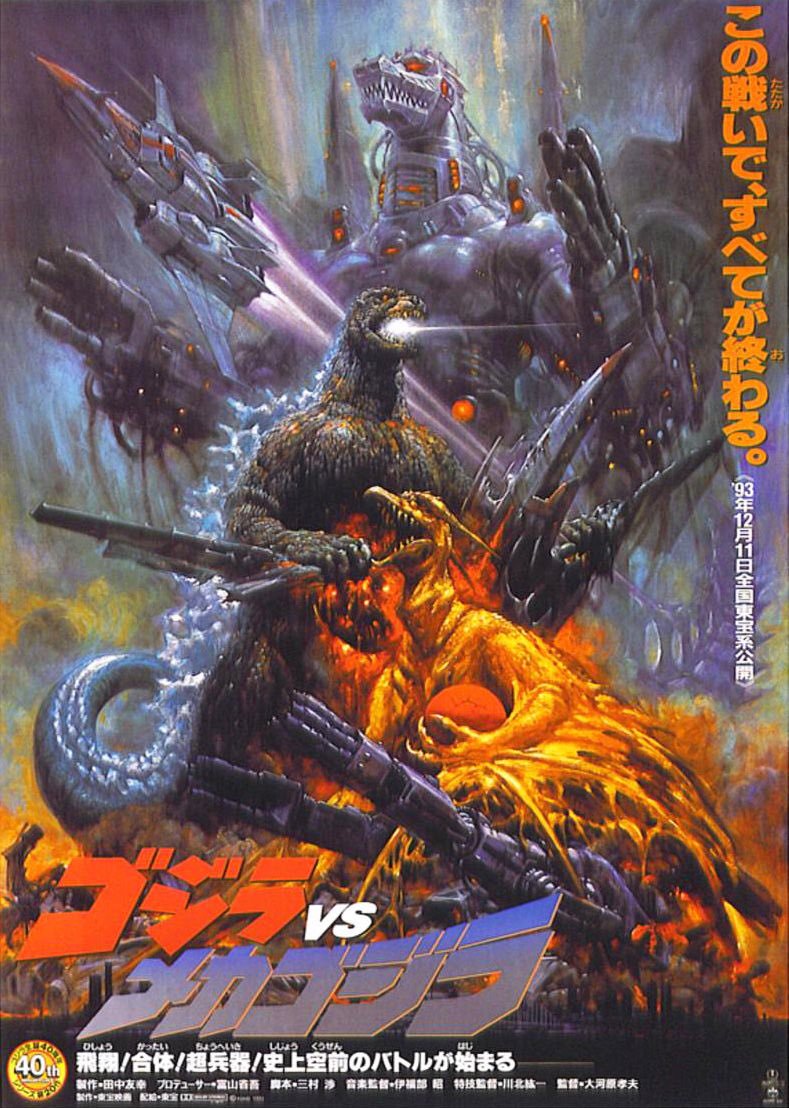
I continue to press on with my journey through the Godzilla Heisei movies. This time, I am focusing on the 5th movie of the series; that is, Takao Okawara’s Godzilla vs. Mechagodzilla from 1993. For clarity’s sake, I will be using the English title Godzilla vs. Mechagodzilla II throughout the review so as to differentiate this movie from the Showa series original made in 1974.
Release Info
Directed by: Takao Okawara Starring: Masahiro Takashima, Ryoko Sano, Megumi Odaka
Language: Japanese Original Title: ゴジラ対メカゴジラ Runtime: 107 min
Synopsis
The United Nations came to the conclusion that they have to do anything in their power to stop Godzilla. For this reason, a special Godzilla Countermeasures Center was created. Their job was to utilise the futuristic technology from the remains of Mecha-King Ghidorah and create a technologically advanced robot that could surpass Godzilla’s might. The final outcome of this research materialised in the form of Mechagodzilla. In the meantime, the Japanese team of scientists on Adona Island finds an egg which gives off a telepathic signal that attracts Godzilla and Rodan. The two monsters rush to protect the contents of the egg, but the military sends Mechagodzilla to intercept them… 
Natural Life vs. Artificial Life
Immediately after the overwhelming success of Godzilla vs. Mothra, Toho greenlit another Godzilla picture. Initially, the producers were toying with the idea of bringing back the good old King Kong, but the studio no longer had the rights to the iconic creature. Consequently, the decision was made to pit the Big G against another classic foe, Mechagodzilla.
In contrast to previous films, Godzilla vs. Mechagodzilla II was not penned by director/writer Kazuki Omori. The screenwriting duties were given to a series newcomer, a major sci-fi buff, Wataru Mimura. The writer realised that writing a Godzilla project may be a one-shot deal for him, so he gave it his all in the screenplay by incorporating lots of action and providing the King of the Monsters with the much-needed dosage of pathos and character motivation.
Unlike the erratic shenanigans of Godzilla vs. Mothra, the Big G is no longer just an angry monster. Godzilla vs. Mechagodzilla II marks his progression from a force of nature to a loving parent because the film presents the viewers with Godzilla Junior! Initially, Takao Okawara was against the idea of bringing back Godzilla’s son, but I have to say the director handled all the sequences involving the creature perfectly. In addition, the design of Baby Godzilla is also extremely kawaii. What is more, the presence of the baby in the finale adds additional gravitas to the kaiju confrontation because viewers start to really root for Godzilla.
Speaking about special effects, these were once again helmed by Koichi Kawakita and all the heavy action scenes are top notch across the board. I am actually surprised that there are a lot of “beam fights” in this movie. Undoubtedly, the epic final battle must have served as direct inspiration for the culminating point of Godzilla: King of the Monsters (2019).
Thankfully, Akira Ifukube returned to compose a music score for the film, and his contributions are simply breathtaking. The main theme of Mechagodzilla is sombre and militaristic at the same time. It grabs your attention from the opening scene! The haunting chorus song accompanying Baby Godzilla is also a composition to be cherished.
With regard to performances, this time round Masahiro Takashima plays the male lead. He already had an experience with Tokusatsu flicks because of his appearance in Gunhed (1989). His presence does not have much impact on the story. To be honest, Ryoko Sano steals the spotlight as a scientist who looks after Baby Godzilla (played by suitmation actor Hurricane Ryu). Their scenes are easily the best in the film.
Evidently, the movie also features many Tokusatsu veterans, such as Akira Nakao, Koichi Ueda, Kenji Sahara, and of course Kenpachiro Satsuma as Godzilla. Megumi Odaka reprises her role as Miki Saegusa once again and her character has surprisingly a lot of stuff to do in this picture. Miki initially helps the team of scientists who are with Baby Godzilla, but the military actually forces her to help them neutralise Godzilla. It is quite an intriguing twist in the story arc of this particular heroine. There is even a deleted scene from the film in which Baby is afraid of Miki because of her psychic connection with the King.
When it comes to home media releases, the distribution duties of Godzilla vs. Mechagodzilla II were mainly handled by Columbia TriStar who produced their English dub for the film. Interestingly, Toho commissioned their own international translation in 1994, but this version is considered to be “lost”. Fragments of it were unearthed a few years ago through Hindi releases of the film, and snippets can be watched here.
Recommendations
If you enjoy Godzilla’s monster rumble at its purest form, the I recommend Godzilla vs. Mechagodzilla II. Toho initially wanted to end the series with this movie, but they changed their mind in view of the delays concerning the American remake. I must say that Godzilla vs. Mechagodzilla II is a solid, action-packed entry of the Heisei era, but it would not be a strong enough conclusion of the series. What is more important, we would not get Godzilla vs. Spacegodzilla and Godzilla vs. Destoroyah (to be reviewed soon).
Overall score: 9/10
«Enjoyed this post? Never miss out on future posts by following us»

BU SU (1987) [Film Review]

BU・SU; or, The Days of Our Lives
     Do your best at school!
Rarely do I stumble across a movie which can be easily labelled as a "weird drama". At the beginning, you suspect that the film will be a standard school romance similar to Shunji Iwai's April Story (1988). Later on, you are convinced that the plot will take a darker turn and veer into the territory of Hideo Gosha's geisha thrillers.
BU・SU is none of these things. Jun Ichikawa's debut feature from 1987 is, indeed, an unconventional story about a young girl trying to get over personal trauma.
Release Info
Directed by: Jun Ichikawa Starring: Yasuko Tomita, Michiyo Okusu, Masahiro Takashima, Yuriko Hirooka
Language: Japanese Original Title: ブス Runtime: 95 min
Synopsis
Mugiko (Yasuko Tomita) leaves her home island of Izu and arrives in Tokyo to live together with her aunt (Michiyo Okusu) who runs a geisha house. Mugiko experienced some kind of tragedy back in Izu (which is confirmed by her school file), so that's why she decided to move away from her mother (who, apparently, was a respected geisha performer back in the day). The girl attends a new school, but she is withdrawn from the hustle and bustle of class-life. She is not even doing great during geisha training supervised by her aunt. Most of the time, Mugiko roams aimlessly through the streets of Tokyo with a vivid expression of bitterness on her face. It is only when classmates force her to participate in a school festival that Mugiko gets a hold of herself and decides to perform the traditional Yaoya Oshichi dance...
The Ugly Duckling
The film's enigmatic title can be roughly translated into English as "an unattractive woman" or simply "ugly". Interestingly, the main heroine (played by then up-and-coming actress Yasuko Tomita) is not by any means ugly. Having been petrified by past experiences (which are shown merely as quick and disjointed flashbacks), she is unable to seize the day and enjoy normal life. Mugiko is sad and withdrawn all the time. As a result, being BU・SU refers to the state of her mental seclusion from other people.
Jun Ichikawa plays out the story of Mugiko in an intriguing manner. The heroine does not experience some Murakami-like quirky adventure or process her trauma. Instead, little by little, she learns that the world is not entirely rotten and chaotic. At school, she becomes friends with a bullied student (Yuriko Hirooka) and an aspiring boxer, Tsuda (Masahiro Takashima). In addition, through her dance training, Mugiko also gains the acceptance of her aunt. Consequently, Ichikawa attempts to communicate a message that no matter how bad things are, there is more to life than just staying bitter.
On the whole, the film unexpectedly becomes a poignant and peaceful slice-of-life flick. The sequences that really stole my heart were the ones of Mugiko roaming through Tokyo of the Bubble Era. We get to see Ginza as well as the famous Shibuya Crossing, accompanied by catchy City Pop songs.
With regard to performances, I have known Yasuko Tomita mostly from her supporting roles in dramas, but she absolutely shines in BU・SU. In a lot of ways, she reminds of Kimiko Ikegami and her dramatic performances. I definitely need to check out more of Tomita's early movies. Honourable mention goes to Michiyo Okusu as the aunt. With her reservation and tranquillity, the actress really makes this character stand out.
Recommendations
If you are in the mood for non-violent/peaceful drama, then BU・SU is the film for you. I was pleasantly surprised by the film's warmth and subtlety when the end credits rolled in. Definitely give it a try during a quiet, wintery night.
Overall score: 8/10
«Enjoyed this post? Never miss out on future posts by following us»