Showing posts with label 1991. Show all posts

To the Zone and Back Again: Exploring the Sheer Awesomeness of Zeiram [Editorial]

 
     Iria, you're definitely a fine looking woman.
 
Well, I realise I am really late to the party, but as they say, better late than never. Of course, I have been aware of the existence of Zeiram ever since a colleague recommended the film and its sequel after my enthusiastic response to Yukito Kishiro’s Gunnm/Battle Angel Alita. However, I was never in the right mood to sit down and watch (what seemed to be) yet another standard Tokusatsu production of the 1990s.
     Thankfully, I changed my sentiment and decided to give the movies a chance after reading a wonderful set of reviews penned by Rise from Phoenix Talks Pop Culture Japan. It is not my intention to rework the wheel and repeat what she did in the form of movie reviews, so allow me to share my perspective on the Zeiram franchise in this one concise editorial. At the same time, I wholeheartedly invite you to read her blog posts as well.
     Now that we have the introduction part off the agenda, it is time for a brief summary of what the heck Zeiram is about for readers unfamiliar with the series. Basically, the titular Zeiram is a gruesome monster that can be best described as an amalgam of good-old Terminator and tongue-swirling Xenomorph. Don’t let its traditional appearance from the Edo period fool you, because Zeiram is a perfect biological weapon that can clone any organism it comes in contact with. The monster’s bloody trail paved with corpses is cautiously followed by Iria (Yuko Moriyama), an intergalactic bounty hunter. Iria and her cybernetic partner Bob (voiced by Masakazu Handa) await Zeiram’s arrival on Earth. In order to limit potential casualties, Iria creates an artificial dimension known the Zone in which she entraps Zeiram; however, two unsuspecting electricians, Teppei (Kunihiro Ida) and Kamiya (Yukijiro Hotaru), end up getting entangled in the otherworldly showdown, which causes further hassle for Iria.
     On the basis of the provided synopsis, one would think that Zeiram (1991) is an adaptation of pre-existing manga or anime, but the movie is a totally original creation by Tokusatsu enthusiast Keita Amemiya, who honed his filmmaking craft in terms of directing, writing, and designing on the sets of Chojin Sentai Jetman, Kyoryu Sentai Zyuranger, and Kamen Rider. Actually, a six-episode OVA was made on the wave of the film’s popularity, but more on that later.
 
    The first Zeiram movie is like a crossover between survival horror and sci-fi adventure comedy. Many viewers out there describe it as a dark riff on Super Sentai/Power Rangers, but to me Zeiram has more in common with the classic Ultraman as well as the aforementioned Battle Angel Alita. My reasoning behind this stems from the film’s minimalist approach. You have to bear in mind that it was a passion project made on a tight budget; hence, we don’t get over-the-top CGI action done in generic Hollywood style.
     What we get, however, is a classic Toku spectacle with in-camera effects, rotoscope animation, and composite shots. This is a classic fun ride at its finest and a true labour of love made by Amemiya who had a clear vision of what he was going for.
What is more, I also have to praise the director because (unlike Shinya Tsukamoto or Koji Shiraishi) he never went full gore in terms of violent action. Zeiram, in spite of numerous mindblowing transformations of the titular creature, never veers off the P-13 territory, so the most demanding viewers may feel disappointed, but the film compensates that with thrilling stunts and loveable characters.
     Firstly, let’s talk about Iria the bounty hunter, brilliantly played by Yuko Moriyama. She is tough, she has the looks, but she is not kawaii. In fact, Iria is the antithesis of a typical Tokusatsu heroine who is frequently played by an idol and objectified on camera. With her eyes and reserved demeanour Iria oozes such confidence and equanimity that she effortlessly gives Ellen Ripley and Sarah Connor a run for their money. Hideaki Anno and Shinji Huguchi, instead of drooling over Masami Nagasawa’s legs, should start taking notes on how to create a truly strong female character.
     Secondly, we have sidekicks. Again, many modern-day viewers complain that the humour generated by Teppei and Kamiya does not work. Personally, I think that scared-to-death blue collar workers on the run from a walking biological warfare is exactly what the film needed. I can’t help but agree with a letterboxd remark that the two guys give off the vibe of Abbott and Costello meet the Thing. On top of this, they have insane teamwork chemistry with Iria in the film’s bombastic finale.
     Clearly, at this point of the editorial, you can tell that the Zeiram movie stole my heart. It is exactly the type of light entertainment I needed to kick off summertime, and I am very happy I got myself round to check it out. The same, however, cannot be said about the sequel: Zeiram 2 (1994).
     The follow-up flick suffers from the same ailment that plagues many sequels out there. That is to say, it tries to be as awesome as the original, but also twice as loud, twice as explosive, twice as action-packed. Keita Amemiya evidently tried to “up the ante” for lack of a better term, but to me, Zeiram 2 is a major step down. Sure, it has great fights and outstanding special effects, but this time we get more bounty hunters, more jumping in and out of the Zone, more blood, and even animal cruelty, which is a major NO for me in such types of films. In this regard, Zeiram 2 has more in common with Mad Max 2: Road Warrior than with the original Zeiram.
     In addition, I appreciate the fact that all of the main actors reprise their roles in the sequel, but the way they act in the film leaves a lot to be desired. Kamiya collaborates with Bob (Kazuhiko Inoue) for a change, which is a nice touch; Teppei is basically lost in the Zone for the majority of the film, and Iria has to single-handedly save her favourite electricians while looking for an artefact straight out of Indiana Jones movie and being constantly interrupted by a rival bounty hunter Fujikuro (SABU) and (of course) upgraded Zeiram. It is not until the finale when the gang is reunited, but the feels are no longer as breathtaking as in the previous outing.
     Ultimately, Zeiram 2 is an okay movie in my opinion. Amemiya tried to be more inventive this time while trying to repeat what worked in the first part. The sequel has clearly great production value because it was made on a bigger budget, but all the action, production design, and special effects did not make me love it. The overall violence should have been slightly ironed out, and the main heroes should have been given more agency in the story.
     Last but least, we arrive at the OVA, Iria: Zeiram the Animation, which was also released in 1994, but without Amemiya’s creative input. This show is often labelled as a prequel to what is presented in the movies, but I personally believe that OVA should not be regarded in such a way. At best, it is a remake that strives to retell the Zeiram shenanigans in a different medium and for a completely different target audience. The whole franchise has come full circle at this point and we finally see Iria as an anime heroine (who is more than kawaii, rest assured). However, her origin story is inextricably linked to Zeiram, which is fine in the context of the show because the creators wanted to feature the titular creature in every episode, but this kind of prequel-making in the style of Ridley Scott only ruins the awesomeness of live-action Iria who undoubtedly must have had many more bounty-hunting adventure apart from just fighting Zeiram all her life.
 
     Consequently, it is best to treat OVA as a separate entity, and I am very glad that I saved it for the end of my Zeiram marathon because had I watched before the films, it would have ruined my perception of Iria for sure. Well, I suspect that this works the other way round and the movies ruin the OVA for anime enthusiasts, but this is the kind of vicious circle that has to be broken by your own preferences.
     Personally, I like the movies more, and specifically the first movie. Check out Zeiram if you can because it is totally worth it: for the story, for the awesome monster, for the kick-ass girl with a gun. My thanks again go to Rise for her blog posts that encouraged me to embark on this sci-fi journey. Peace out to you all and see you around in the Zone.
«Enjoyed this post? Never miss out on future posts by following us»

Godzilla vs. King Ghidorah (1991) [Tokusatsu Review]

Godzilla vs. King Ghidorah; or, There Can Only Be One
     I nearly died on Lagos Island, along with my entire Garrison, but the dinosaur saved us all. Now, all of that prosperity I built is now being destroyed by the same dinosaur at this moment, and there’s nothing I can do about it. Very ironic, don't you think?
It has been a while since Godzilla, the one and only King of the Monsters, was discussed on this blog. In view of the recent release of Shin Ultraman and the news that Toho is actually making a new Godzilla movie, I am back in the Tokusatsu mode again and decided it would be fitting to finally come round and complete my reviews of all Japanese Godzilla flicks. A daunting task for sure, and some reviewers I follow and respect already undertook this endeavour, but still, I feel I should explore the heart of Godzilla on my own and provide my personal take on the nearly 70-year-old franchise. For this reason, I would like to talk today about my favourite Goji-movie of all time, especially in view of the recent passing of director Kazuki Omori; that is, Godzilla vs. King Ghidorah.
Release Info
Directed by: Kazuki Omori Starring: Isao Toyohara, Anna Nakagawa, Megumi Odaka
Language: Japanese Original Title: ゴジラ対キングギドラ Runtime: 103 min
Synopsis
Tokyo, 1991. An unidentified flying object appears on the Tokyo skyline. The Japanese government is afraid that this may be an alien invasion, but it turns out that the mysterious visitors are people who travelled back in time from the 23rd century. They claim that in their time period Godzilla led to total annihilation of Japan, and the only way to stop the monster is to prevent its origin. A joint research team comprised of Emi Kanno (Anna Nakagawa), an android M-11 (Robert Scott Field), a freelance journalist Terasawa (Isao Toyohara), Dr Masaaki (Katsuhiko Sasaki), and Miki Saegusa (Megumi Odaka) jumps in time to the year 1944 and carries out the difficult task. Godzilla has been wiped out from existence, but his monstrous reign has been taken over by King Ghidorah. Now, humanity's only hope is to bring back the Big G.
Days of Future Past
After the release of Godzilla vs. Biollante (1989), the Toho Studios found themselves in a slump with the series. According to Steve Ryfle’s book Japan’s Favorite Mon-star: The Unathorized Biography of Godzilla (1998), Godzilla vs. Biollante was the most expensive production of the franchise at the time of its making, but modest box office performance ultimately made the studio loose 3 million yen on the picture. After two (if counting The Return of Godzilla from 1984) so-so attempts to jumpstart the franchise, producer Tomoyuki Tanaka made a decision to appeal to the fans’ nostalgia. Therefore, Godzilla was to be pitted against his arch-nemesis from the Showa era, King Ghidorah.
Scripting and directorial duties were once again given to Kazuki Omori, the man who cooked up Godzilla vs. Biollante. However, this time Omori put less emphasis on the human drama. Instead, he cranked up the science-fiction aspect to the max, and also added his personal commentary on (or rather critique of) Bubble Era Japan’s international relations.
Godzilla vs. King Ghidorah is often regarded by fans and ordinary movie enthusiasts as the underwhelming entry of the Heisei series, primarily due to its convoluted plot concerning time travel. Steve Ryfle obliterates the movie’s plot in his book in a very shallow and condescending way, repeating many claims from viewers who did not pay attention while watching the film. In fact, if you watch the film while having fresh in mind the events of other Heisei series instalments, the events of Godzilla vs. King Ghidorah do make sense, and the film adds more context to the mythos of the Big G and his arch-nemesis in a very bold and straightforward manner that was only outmatched by the grandeur of the original Gojira (1954) and Shin Gojira (2016).
What I am getting at is that I love in this movie all the elements that are oftentimes perceived by critics of this film as campy: time travel, a Terminator-like android, countdown to a big explosion, Godzilla originating from a dinosaur, King Ghidorah originating from kawaii squishy Gremlin-like creatures called Dorats, Mecha-King Ghidorah. The list goes on! Godzilla vs. King Ghidorah is a wild, escapist fun that takes itself seriously only at certain places.
These places are obviously Omori’s own thoughts about the leading role of Japan on an international stage. The period of the 1980s indeed seemed as the time of Japan’s economic dominance, but this prospect was clearly gone with the wind by the year 1991. Omori not highlights the ever troubling issue of Japan’s resentment of nuclear weapons (Big G actually destroys a nuclear sub to regain his strength), but the director also underlines heavy preoccupation of the Japanese with rampant consumerism and lavish lifestyle, which may ultimately lead to disastrous consequences.
This is perfectly reflected in an emotional confrontation scene between Godzilla on the loose and a war veteran Shindo (now a prosperous businessman who took part in rebuilding Japan). This scene alone is a wonderful stand out in an entire franchise, which not only ties Godzilla to the people of Japan, but turns the monster into a token of warning against authority power and mindless accumulation of wealth (see Godzilla’s destruction of the Tokyo Metropolitan Government Building in the film’s finale).
Speaking about special effects, the practical stuff, miniatures, monster fights, and cell animation helmed by the late Koichi Kawakita are simply outstanding. The production design, especially of the Futurians’ ship, is beautiful to look at as well. One has to appreciate the dedication of the Toho team in the modern age filled with computer-generated images. What is more, Akira Ifukube himself was brought back to the franchise as the film’s composer after 16 years of break. I have already outlined my thoughts on Ifukube’s compositions in my series of blog articles last year, but allow me to say here that I adore the music score for Godzilla vs. King Ghidorah. Indeed, Maestro Ifukube may have reused a lot of old compositions, but these fit so well with this picture, especially the action themes reappropriated from Godzilla vs. King Kong (1962).
With regard to performances, Isao Toyohara does a decent job as the male lead. Megumi Odaka reprises her role of Miki Saegusa from Godzilla vs. Biollante. She already gained experience on the set of the previous film, so she perfectly knew how to react to monster fights that were added later in post-production. The late Anna Nakagawa is also memorable as Emi Kanno, the mysterious lady from the future who ultimately joins the good guys and becomes a pilot of Mecha-King Ghidorah. Robert Scott Field is a joy to watch as an android M-11 in action. The supporting role of Shindo played by Tokusatsu veteran Yoshio Tsuchiya is also a welcomed addition.
Contrary to some misleading info on the net, Godzilla vs. King Ghidorah did become a success at the Japanese box office and managed to reinvigorate an interest in the franchise. For a brief period of time, Toho even considered making a direct sequel to the film titled Counterattack of Ghidorah, but the plans fell through in favour of brining back another familiar monster from Godzilla’s lore (Mothra). Unfortunately, Godzilla vs. King Ghidorah was released on VHS and subsequently on DVD in the West with a crappy English dubbing that really sucked excitement out of the viewing experience. If you want to enjoy the film in its original, unabridged form, then you have to rely either on the Japanese DVD or Blu-Ray release.
Recommendations
All things considered, I will never forget the time over 20 years ago when I sat down in front of TV and watched my first Godzilla movie: this movie. Godzilla vs. King Ghidorah may be bonkers to some, but still, it is positively charged with action and science fiction vibes. What is more, it is one of the few movies in the franchise that served as an inspiration for Godzilla: King of the Monsters (2019) blockbuster. The legacy of this Heisei era movie continues to live on. Please refer to an epic fan-made trailer below to experience the visuals on your own.
Overall score: 10/10
«Enjoyed this post? Never miss out on future posts by following us»

Shuto Kousoku Trial 3 (1991) [Film Review]

Shuto Kousoku Trial 3; or, Remember Me
     I'll race you anytime as long as it's on the track.
Shuto Kousoku Trial 3 is yet another entry in the popular racing series from Nikkatsu studio. Apart from being a sequel with the shortest runtime (barely 65 minutes), this movie is also known for being the debut flick of Reiko Takashima(!) Without further due, let’s buckle up and drive through the third movie about the legendary Shuto Expressway.
Release Info
Starring: Kazuhiko Nishimura, Reiko Takashima, Ikuo Fukada
Language: Japanese Original Title: 首都高速トライアル 3 Runtime: 65 min
Synopsis
Kyohei (Kazuhiko Nishimura) is a former holder of a record time run at Shuto Express. He retired from illegal racing and now works as a mechanic for Keiichi Tsuchiya’s racing team. Kyohei’s friend, Yusuke (Ikuo Fukada), still hits the street with his Nissan Silvia. One day, while practicing in the mountains, he is challenged by a mysterious driver in a Toyota Supra. Yusuke barely manages to survive the confrontation. Kyohei, on the other hand, witnesses a car accident while practicing in Skyline R32. This event makes him recollect a horrible accident from the past. He tries to persuade Yusuke to give up street racing; however, a friend takes up another challenge from Toyota Supra and dies during the race. Kyohei returns to Shuto Expressway in order to face off against the mysterious driver. It turns out that everything is connected to a tragic incident from the past...
Catch me, darling!
I have to say that Shuto Kousoku Trial 3 is by far the weakest entry in the series, but it is not by any means unwatchable. Evidently, the screenplay is just an excuse to get to car action, but the director interpreted this rule too literally. Consequently, what we have is a film with shoddy editing, only one City Pop song, and (potentially) the best storyline of the series that got lost in translation…
It feels as if well over 30 minutes of footage involving the characters ended up on a cutting room floor, so that there would be more space for decent racing sequences. Honestly, these are the only worthwhile aspects of the film. Interestingly, I could not understand the director’s decision to use only one (great) song: MAHARA’s Crying All Night; and then sync the rest or car action to random incidental music. This creative choice significantly tones down the viewing experience.
Still, I love the appearance of young Reiko Takashima as a journal writing about Keiichi Tsuchiya, and street racing in general. She provides the necessary charm and charisma, but her limited screen time is a big disadvantage. The screenplay constantly revolves around her character, and it is pretty obvious who she really is halfway through the film (no spoilers), yet Reiko is not given the chance to properly shine. All in all, it is a pleasure to see her in a non-drama role.
Additionally, maybe it is only my impression, but Keiichi Tsuchiya appears to be totally disinterested on the screen. He only shows up to repeat the message from the second film, do some cool drifting in R32, and that’s it. Personally, I think that he did much better as “the mentor figure” in Shuto Kousoku Trial 5 & 6.
Recommendations
I recommend Shuto Kousoku Trial 3 only for the cars and Reiko Takashima’s appearance. Subsequent entries in the series have learned a lesson from this sequel and tried to tell more compelling stories about the drivers chasing fortune and glory on the Shuto Expressway.
Overall score: 6/10
«Enjoyed this post? Never miss out on future posts by following us»

Tiger Cage 3 (1991) [Film Review]

Tiger Cage 3; or, Beware of Femme Fatale
     What have I done? In this world, whoever gets the money also gets the power!
The third part of Tiger Cage is also the final instalment of Yuen Woo-ping’s action thriller trilogy. Interestingly, this particular movie is a sharp breakaway from the style set by the previous pictures. There is more emphasis on drama and economic espionage. Is Tiger Cage 3 a worthy conclusion of the saga about righteous police officers from Hong Kong? Let's see together.
Release Info
Directed by: Yuen Woo-ping Starring: Kwok Leung Cheung, Michael Wong, Sharla Cheung
Language: Cantonese Original Title: 冷面狙擊手 Runtime: 98 min
Synopsis
Inspector James (Kwok Leung Cheung) and his colleague Inspector John (Michael Wong) are investigating a businessman called Lee Siu Bong (Kam-Kong Wong). Thanks to James’ girlfriend, Suki (Sharla Cheung), who works for Lee, the police obtains documents which incriminate the businessman. However, Lee Siu manages to get the papers. He also kidnaps Suki and injures James. In the meantime, John is discharged from the force due to accusations of carrying out blackmail. The friends join forces in an attempt to get even with Lee. However, things do not appear to be as they are…
The Streets Are Hot
After seeing Tiger Cage 1 & 2, I was hopeful that Yuen Woo-ping will deliver yet another action flick with well-made choreography and fast-paced fights. However, Tiger Cage 3 seems to be more like a mash-up between Sam Raimi’s Darkman (1990) and The Bold and The Beautiful (1987) soap opera. Seriously, the main protagonist, Inspector James, ends up getting disfigured by the bad guys due to the documents of his sweetheart (just like in Raimi's film). What is more, the alliances between characters shift more frequently than Windows 10 updates. Towards the third act, you can get pretty confused in the maze of plot twists.
Nevertheless, if you are a fan of Sharla Cheung, then you will find her as the redeeming factor of this story. In fact, Tiger Cage 3 is all about Sharla and her sex appeal. In addition, each scene is an excuse to put her into a new 1980s dress. Honestly, I think that Sharla was doing a much better job in Stephen Chow’s comedies, whereas in Tiger Cage 3 her performance is mediocre at best.
What about the action? Don’t get your hopes, because the fight sequences are scarce. The only confrontations worth nothing are Kwok Leung Cheung vs. John Cheung showdown and the finale at a rooftop of a skyscraper. What is more, Michael Wong is criminally underused in this picture (Yet again, when counting his short appearance in Magnificent Warriors). Michael seems to be the only actor experienced enough to carry this movie, but weak script brings everything down.
That being said, I enjoyed the picturesque panorama of Hong Kong. Tiger Cage 3 is one of the rare movies which show how awesome the city’s downtown area really is. This place is truly one of a kind.
Recommendations
I recommend Tiger Cage 3 only for die-hard fans of Yuen Woo-ping. This movie is the only entry in the trilogy which was made without any solid idea. I guess Yuen must have really liked Darkman when it came out and he wanted to replicate those vigilante vibes. Try to refer to D&B company’s other productions instead, like In the Line of Duty series.
Overall score: 5/10
«Enjoyed this post? Never miss out on future posts by following us»

A Chinese Ghost Story III (1991) [Film Review]

A Chinese Ghost Story III; or, Heavenly Dilemma
     Why are you telling me your name? I won't be visiting you, and you won't be visiting me. Man and ghost can't be together... Even if you were human, it'd be hopeless because monks and women can't be together. Remember to be more careful in future. If you meet other monks, they won't give you a chance. Take care of yourself!
Tsui Hark and Ching Siu-tung did not wait long to release the next follow-up, as A Chinese Ghost Story III saw the light of the day just one year after the premiere of the second part. This particular motion picture; however, feels more like a soft reboot rather than proper continuation.
Release Info
Directed by: Ching Siu-tung Starring: Tony Leung Chiu-Wai, Joey Wong, Lau Yuk-ting
Language: Cantonese Original Title: 倩女幽魂III:道道道 Runtime: 104 min
Synopsis
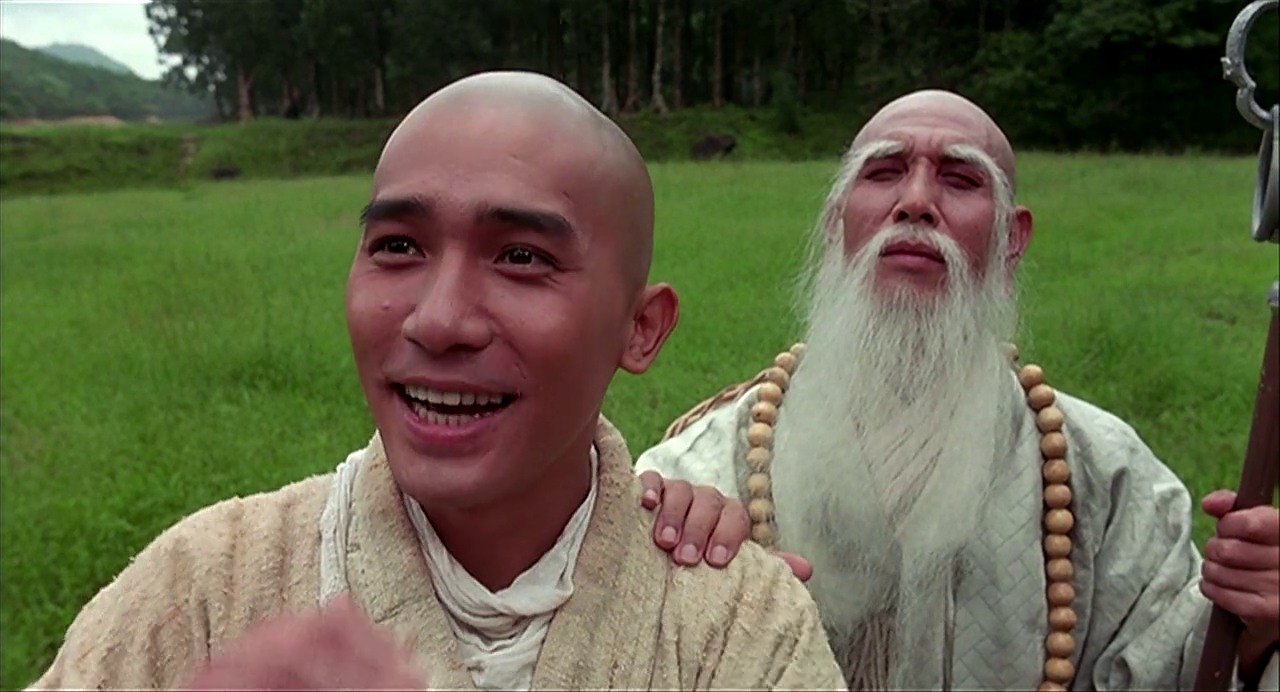
The film begins with a flashback from the first film in which we see the fight between Yin Chik-ha (Wu Ma) and the Tree Demoness (Lau Siu-ming). The monk manages to imprison the demon via magical seal, but it breaks after 100 years. This is the beginning of a new story centering on a young Buddhist disciple, Shi Fang (Tony Leung Chiu-Wai), and his master (Lau Shun) who are travelling to the Imperial City in order to deliver the figure of a golden buddha. For fear of being robbed by thieves, they spend a night in a haunted place known as the Orchid Temple (the same place from the first film). There, Shi Fang is being seduced by a ghost called Lotus (Joey Wong), but the monk remains resilient to her charms. In order to avoid detection by the master, Shi Fang lets Lotus escape. As a way of returning the favour, Lotus attempts to protect Shu Fang from her mischievous sister Jade (Lau Yuk-ting) and the Tree Demoness. Nevertheless, Lotus’s intentions are exposed and Shu Fang is forced to seek the help of a noble mercenary Yin (Jacky Cheung).
100 Years Later
Fans of the series often point to A Chinese Ghost Story III as the weakest of the bunch. Understandably, the movie suffers from the lack of Leslie Cheung and Wu Ma, and falls into repetitiveness (the return of the Tree Demoness). Also, Joey Wong plays an entirely different ghost this time. Yet, the film still manages to be its own thing.
There is room for comedy as well as action. There are also fantastic dynamics between Tony Leung’s character and Joey Wong’s ghost. Their relationship is not a simple rehash of the romance between Choi-san and Siu-sin because the young monk tries as hard as possible not to be physically interested in Lotus, which leads to a lot of hilarious bickering between the two characters.
What is more, A Chinese Ghost Story III puts a lot of emphasis on the aspect of Buddhism. While in the previous pictures, the monks used sutras and special charms to fight the evil spirits, here we have beads, special paint, golden buddhas, flying carpets, and divine light pit against snakes, swirling tongues, and lighting bolts. Tony Leung transforming into a glowing red buddha in the film’s finale is arguably one of the coolest things ever.
Recommendations
I recommend A Chinese Ghost Story III to anyone who would like to experience an action-packed fantasy story with comedy elements. Personally, I believe that the original trilogy works so well primarily because of Joey Wong. Throughout the three films, she played different roles which really showcased her acting range and talent.
Overall score: 8/10
«Enjoyed this post? Never miss out on future posts by following us»

A Scene at the Sea (1991) [Film Review]

A Scene at the Sea; or, The Calmest Ocean
     He comes every day. He's getting much better.
A Scene at the Sea is the third feature film directed by the great Takeshi Kitano. Interestingly, it is also one of the few director’s filmmaking endeavors which do not contain overt violence or yakuza references. Instead, the movie tells the simple story of love between people and love for the ocean.
Release Info
Directed by: Takeshi Kitano Starring: Claude Maki, Hiroko Ooshima
Language: Japanese Original Title: あの夏、いちばん静かな海。Runtime: 100 min
Synopsis
Shigeru (Claude Maki) is a young man who is a deaf-mute. He works as a helper at a company which deals with garbage collection. One day, while collecting garbage, Shigeru spots a broken surfboard. He takes the board with him and fixes it. With the help of his girlfriend Takako (Hiroko Ooshima), who is also a deaf-mute, Shigeru takes the surfboard to the seaside and starts practicing. He is determined to learn how to surf.
Kitano Blue
Similarly to Boiling Point (1990) and Getting Any (1994), A Scene at the Sea remained a rare Kitano film which was hard to track down in the West. Nevertheless, thanks to the power of the internet, I finally managed to watch it.
Think of this movie as it were a crossover between Charlie Chaplin’s City Lights (1931) and Luc Besson’s Le Grand Bleu (1988).Takeshi Kitano himself expressed in an interview that a painter needs only one image in order to tell a story, whereas a film requires 24 images per second in order to get anywhere. So, it was his intention to make a film in which the story is told not through dialogues but visuals. If it had not been for occasional remarks of the supporting characters, A Scene at the Sea could very well be classified as a silent film.
Nevertheless, it is so gorgeous looking! Every aspect of the production, from the performances through shooting locations to cinematography, is just outstanding. I can’t get enough of the seaside locations featured in the film. Additionally, whenever Joe Hisashi’s music score kicks in, I get super elated.
Kitano admits that if it had not been for Hisashi’s music, the movie would not have been such a powerful viewing experience. Indeed, the score really enhances many scenes, such as the bus stop sequence, Shigeru’s training, or the tear-jerking ending.
In addition, I have to praise the performances of Claude Maki and Hiroko Ooshima who played just with their expressions. Maki would go on to appear in Kitano’s later film, Brother (2000), whereas Ooshima did not continue her movie career. A Scene at the Sea remains her only acting credit to date. Interestingly, the movie marks the first appearance of Susumu Terajima as Kitano’s regular.
Recommendations
If you want to see the poetic side of Takeshi Kitano, then A Scene at the Sea is a must see! It is a quiet story about an (extra)ordinary couple and their passion set amidst the calming blue. Highly recommend it.
Overall score: 9/10

«Enjoyed this post? Never miss out on future posts by following us»

Raise the Red Lantern (1991) [Film Review]

Raise the Red Lantern; or, Desperate Housewives
     “If I’m able”… You just wait and see what I can do!
Raise the Red Lantern is a 1991 drama film directed by Zhang Yimou and based on a novel "Wives and Concubines" by Su Tong. It is frequently cited as one of the best Chinese movies of all time. It even received the Academy Awards’ nomination for the Best Foreign Language Film in 1992. Being a sceptic at first, the movie struck me with its gripping storyline, wonderful art design, and breathtaking cinematography.
Release Info
Directed by: Zhang Yimou Starring: Gong Li, He Saifei, Cao Cuifen
Language: Mandarin Original Title: 大紅燈籠高高掛 Runtime: 125 min
 
Synopsis
China, the 1920s. Songlian (Gong Li) is a university student who mourns the death of her father. After nagging from her step-mother, and in view of dire financial situation, she drops studying and decides to become a wife of a wealthy businessman. She marries into the Chen family, acquiring the status of the Fourth Mistress. Songlian familiarises herself with all the peculiar customs at the house, many of which involve the usage of lanterns. Little does she know that there is a strong competition among the Mistresses for the favours of Master Chen (Ma Jingwu). Songlian has to find her way through the maze of conspiracies and compete with Yuru (Jin Shuyuan), Zhuoyun (Cao Cuifen), Meishan (He Saifei), and her servant Yan’er (Kong Lin).
 
The House of Intrigues
Even though I have not read Su Tong’s novel, the style of Raise the Red Lantern reminded me greatly about the works of Anchee Min, and Lisa See. Probably because the two authors also explore the relations between women in their novels. Similarly, Raise the Red Lantern predominantly focuses on women rather than men. We never see the close up of Master Chen, loyal servants are always in the background, whereas Chen’s eldest son, Feipu (Xiao Chu), has only two brief exchanges with Songlian which do not go particularly well. Men are only the burden in this story, tricking women into obedience and submission.
 
In the case of women, on the other hand, the situation is a bit different. When someone is outwardly arrogant, you would think that this person is the baddie; but in fact, the worst kind of a villain is the one with the warmest smile. Women compete between each other ruthlessly in order to acquire higher status, which is a part of Sailong’s tragedy because she does not know how to stay afloat in this dying ground filled with customs and colours. Speaking of which, red colour plays the pivotal role in the film. You can see the whole courtyard and rooms being lit with red, or even characters dressed up in red. In my opinion, red lanterns stand for the tragic fate of Chinese women.
 
From the technical side, the aforementioned cinematography elevates the viewing experience. The movie was shot on location in old Qiao’s Family Courtyard, a lavish, extremely symmetrical residential compound built in the 18th century. Every shot of that compound can be framed and hanged on a wall. It’s that beautiful. In addition, the haunting music score by Zhao Jiping cannot go unnoticed. In many scenes, the music transpires naturally from the film (for instance, playing vinyl records or Meishan's (the Third Mistress) wonderful courtyard singing sequence); however, the music can also be heard in the background of the key scenes.
 
With regard to performances, Gong Li is absolutely amazing in the leading role. However, Cao Cuifen and He Saifei are also brilliant as the competing Mistresses. Relatively young Kong Lin has a very good role as Songlian’s servant.
 
Recommendations
If you have not yet seen Raise the Red Lantern, then please watch it. The film is a wonderful story that will certainly leave you thinking about many social issues. Be careful to grab a decent DVD edition of the film because many releases had quite bad picture quality. All in all, Raise the Red Lantern is Zhang Yimou’s best of the best.
Overall score 8/10