Sanjuro (1962) [Film Review]

Sanjuro; or, Return of Yojimbo
      It's a stupid plan, but some excitement might keep me awake.
This week’s review will be about the only sequel in Akira Kurosawa’s career. Following the overwhelming success of Yojimbo in 1961, Toho executives pressed Kurosawa to make a follow-up story. As a result, Sanjuro was released a year later with Toshiro Mifune reprising his role of a wandering ronin, marking the 14th successful picture in the Kurosawa-Mifune collaboration
Release Info
Directed by: Akira Kurosawa Starring: Toshiro Mifune, Tatsuya Nakadai, Yuzo Kayama, Takashi Shimura
Language: Japanese Original Title: 椿三十郎 Runtime: 95 min
 
Synopsis
Eight samurai led by Iori Izaka (Yuzo Kayama) meet together in an isolated shrine and discuss their issues. Iori suspects that his uncle, Chamberlain Mutsuta (Yunosuke Ito), might be involved in corruption since he tore up his nephew’s petition against organised crime. Thus, Iori went to the Superintendent for help and the latter reluctantly agreed. Nevertheless, it turns out that the Chamberlain was never involved in any dubious activity and that the Superintendent is the real villain. After imprisoning Mutsuta and his family, nine helpless samurai have nobody else to rely on than a shabby, yet extremely wise ronin who was sleeping in the shrine and overheard their conversation, Sanjuro Tsubaki (Toshiro Mifune).
Sanjuro vs. Yojimbo
After making Yojimbo, Kurosawa wanted to move on to something different in the samurai genre and, for instance, make a movie about a day in life of a samurai who is about to die, but due to Toho’s decision about Yojimbo’s sequel, he proceeded to adapt a story by Shugoro Yamamoto called Peaceful Days and positioned Mifune’s ronin as the story’s protagonist.
 
Interestingly, Kihachi Okamoto’s Kill! (1968) was also based on this novel and a number of similarities can be observed between the two films. However, they differ significantly in their tone. Whereas Kill was a parody of chanbara films and a satire on samurai lifestyle in general, Sanjuro poses a question of what it takes to be a good samurai. In Yojimbo, Sanjuro was acting for his own personal gain when playing off the leaders of two rival clans against each other, but in the sequel, we see him taking action due to his empathy for nine samurai in need. He wants to help because it is a right thing to do, yet, rest assured, he does not go soft on killing bad guys.
I admit that Yojimbo is a masterpiece which made its impact on popular culture, sparking numerous remakes and references, but storywise, Sanjuro feels to be a superior picture. Yojimbo provided great fun and action, but never really explored its protagonist’s personality. The sequel complements that hole and goes even further. Sanjuro becomes almost like a father figure to the young and impulsive samurai and, at the same time, he learns from the gracious Lady Mutsuta (Takako Irie) that “the best sword stays in its scabbard”. In consequence, Sanjuro has greater understanding for his adversary, the Superintendent’s henchman, Hanbei Muroto (played by the legendary Tatsuya Nakadai) whom he has to face in the finale’s electrifying showdown.
In terms of behind the scenes trivia, the morbid death of Nakadai’s character was allegedly done in one take and, accidentally, turned out to be more spectacular than intended. Supposedly, a compressor hose attached to Nakadai burst at one spot and a much larger gush of fake blood spilled out. The impact of the hose’s pressure was so strong that Nakadai was nearly lifted off the ground (which can explain the quick cut to Sanjuro’s close-up). Nevertheless, the death itself still looks impressive.
Recommendations
To sum up, Sanjuro is a great continuation of Yojimbo. Professionally directed (as always by Kurosawa), brilliantly acted (not only by Mifune but by Nakadai and other cast members as well), and with a great music score (composed by Masaru Sato- yet Yojimbo’s original theme can’t be heard until the closing shot of the film). It’s a shame that the third part was never conceived, because out of Kurosawa’s filmography, Yojimbo seemed the best material for a series. Although Mifune made unofficial sequels in 1970 with Hiroshi Inagaki (Incident at Blood Pass) and Kihachi Okamoto (Zatoichi vs. Yojimbo), I would love to see Kurosawa’s continuation of the ronin’s adventures.
Overall score: 8/10

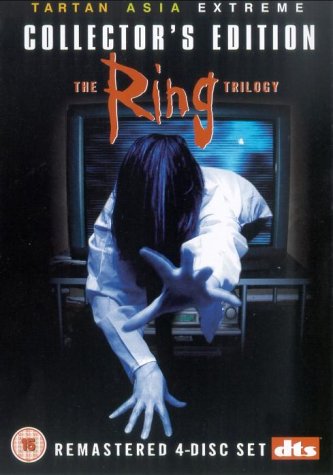
Ring (1998) [Film Review]

Ring; or, You really should’ve demagnetized that vhs tape!
This week’s review will be about a classic J-horror film, based on a classic horror novel by Kôji Suzuki, the success of which sparked the series of sequels, Korean spin-offs, and American remakes of dubious aesthetic values. Put down your toilets seats and let’s discuss Ringu.
Release Info 
Directed by: Hideo Nakata Starring: Nanako Matsushima, Hiroyuki Sanada, Rikiya Ōtaka, Rie Inō
Language: Japanese Original Title: Ringu Runtime: 95 min

Plot
A TV reporter, Reiko Asakawa (sweet as honey Nanako Matsushima) is investigating the urban legend of a cursed vhs tape that allegedly kills everyone after the period of seven days since viewing it. After the mysterious death of her niece, Tomoko (Yūko Takeuchi), Reiko discovers that three of Tomoko’s friends also died exactly on the same night. When it turns out that they spent a night in a cabin a week earlier, the reporter drives down to the Izu peninsula immediately and finds the unlabelled tape... Driven by curiosity (of course!), Reiko plays it and becomes another victim of the horrible curse. What’s more, her small son (Rikiya Ōtaka) also watches it accidentally. With the help of her ex-husband, Ryuji (Hiroyuki Sanada), Reiko sets out on a quest to discover who created the evil tape and how to stop the curse before it is too late for her and her child.
 
Ring a Ring o' Ringu 
I would like to make myself clear that I’m writing this review from a standpoint of a person who neither have read Suzuki’s novel nor have seen the American remake as the first one (contrary to many Polish viewers). Having refreshed Ringu years after I checked it out on vhs, all I can say is that to me... it’s not a horror. With its intriguing story and the way it was executed, Ringu just does not seem to fit into this category. I think that it’s actually above the horror genre. It’s a well crafted mixture of a psychological thriller and a mystery flick with a few great jump scares. 
Even though I haven’t read the literary original, I’m aware that there were significant changes made to the plot itself and especially to the leading character; nevertheless, the movie is still interesting. It was quite a bold move to change the literary protagonist from a father trying to save his daughter to a mother trying to save her son (unintentional correspondence to Silent Hill?) and Nanako Matsushima manages to deliver the part along with great support from Hiroyauki Sanada as an ex-husband/disillusioned genius/medium. However, I was convinced that all of a sudden Eikichi Onizuka would pop out from a closet screaming “It’s a prank Fuyutsuki-sensei!”. Seriously, Great Teacher Onizuka (1998) is such a classic J-Drama that it’s hard not to associate Matsushima with it, even when seeing her in something completely different.
In terms of special effects, the movie does not make a great use of them, but they do their job when needed. The footage from the tape itself is extremely gripping and creepy at the same time, and that grainy effect only amplifies to its charm. The final sequence of Sadako (Rie Inō) coming out from a TV is also very well made and holds up even by today’s standards.
Speaking about the curse itself, I was left a little bit in the dark here. Namely, what was the exact purpose of Sadako’s creating the cursed vhs tape in the first place? From Reiko’s investigation we come to know Sadako’s mother tragic story and how Sadako was killed by her own father. Also, there was no local broadcast in Izu when the first victim was recording the tape, but Sadako herself was transmitting the images from the bottom of the well (I’m writing this solely on the basis of this film, if there’s an additional explanation to it, please write in the comments). Thus, on the basis on the curse, we can infer that Sadako’s intention behind creating the tape was to make as much people as possible aware of her disastrous plight. But... shouldn't there be some warning on the tape or a disclaimer before the footage about breaking of the curse by copying and making somebody else watch the vhs?
Sadako’s brilliant plan is simply pointless without it. Prior to the events of the film, random people who were residing in the cabin just died after viewing the tape. It was Reiko who initiated the chain of constant copying and watching as we see her riding with the VCR to her father at the end of the film. To be honest, I don’t feel sorry for Sadako at all (again, judging only by the film). She was one crazy sadist who had to keep on giving even after her death. As for the tape itself... just put it on top of the speakers and the wonderful process of demagnetisation will get rid of Sadako’s curse once and for all.
Recommendations
Recommended to every avid viewer of Japanese cinema and beginning horror fans in general. Ringu is an unusual flick with a plot that keeps you interested right up until the end. Decent performances, great screenplay, and that unique feeling of J-horror eeriness are its main advantages. Definitely worth checking out.
Overall score: 8/10

Godzilla Resurgence Official Trailer Breakdown [News]

Finally! Official full-length trailer for Godzilla Resurgence (2016) (original title: Shin Gojira) was released just yesterday:
When I watched it for the first time, I did not know what to think, but after re-watching it again and again and again, I'm full of hopes that Toho will deliver a decent quality Godzilla film. Below, you can read my thoughts on some of the selected screenshots from the trailer:

1. Tohoscope
Good old Tohoscope. A very nice nod to the Showa series by including the original logo.

2. The Roar
It's great to hear the original roar again, but... if the directors want to include this CGI shot in the actual movie, they should definitely improve it first.

3. That TAIL(!)
It is totally out of control! And... is it even taller than the King himself?! I hope that he will make a good use of it.

4. Sinister Smile
I approve the reinvented appearance of Big G (though I still love Legendary's one). It seems that the King spent his retirement years sunbathing in Mordor, but it's an interesting change that tries to stay true to Godzilla's original design.

5. People, People, People
The Japanese officials mobilising are always a pleasure to watch.

 And what would be your reaction if you had found out that Godzilla crushed your Toyota?

Love is in the air? If hope not. This is a Godzilla film, not a romantic drama.

 A familiar face? Unfortunately, I'm unable to name the actor. Kudos for anyone who can recognise him.

Having more than one actress in a Godzilla film is always great news.

This scene is a clear hint that we should expect a lot of talking in the movie.

Clean-up services are going to have a very busy day, hopefully with paid overtime.

6. Godzilla vs. JSDF
An expected standard, but for this single shot only, Toho should just shut up and take my money!

7. Premiere
This guy is really pissed about the release date and I'm not surprised.

All in all, I'm impatiently waiting to see Godzilla Resurgence! And what do you think about the trailer? Feel free to express your thoughts in the comments.