Showing posts with label mamoru oshii. Show all posts

Patlabor 2: The Movie (1993) [Anime Review]

Patlabor: The Movie 2; or, Tinker, Tailor, Ingram, Spy
     The line that separates a just war from an unjust peace isn't very clear. Ever since hypocrites have made peace their just cause, we've lost faith in that peace. Just as wars give rise to peace, peace also gives rise to war. An empty, hollow "peace" that only defines itself as "not war" will eventually be replaced by something that is a state of war in all but name.
After the successful Patlabor: The Movie (1989) and Patlabor: The New Files OVA (1990-1992), Headgear decided to put the franchise to a rest with Patlabor 2: The Movie (1993) directed by the famous Mamoru Oshii. In contrast to the previous entries, the final chapter of the Patlabor series feels like an espionage thriller with philosophical ponderings about life known from Ghost in the Shell (1995). However, first and foremost, this anime feature is Oshii’s personal protest against Japanese politics.
Release Info
Directed by: Mamoru Oshii Voice actors: Yoshiko Sakakibara, Ryuusuke Oobayashi, Miina Tominaga, Toshio Furukawa
Language: Japanese Original Title: 機動警察パトレイバー2 the Movie Runtime: 108 min
Synopsis
Three years after the events from the first movie, we see that the members of SV2 Section 2 have gone their separate ways. Noa and Shinohara are now Labor testers, whereas Ota has become an instructor at the police academy, and Shinshi has been transferred to Tokyo MPD. The only people who stayed in SV2 are Hiromi Yamazaki as well as Captain Goto and Captain Nagumo. All of a sudden, the Yokohama Bay Bridge is destroyed by a military missile. This event sets into motion a domino effect which leads to a growing conflict between the Japanese government and JSDF forces. Goto and Nagumo believe that a person responsible for all this is a former UN soldier, Tsuge, who wants to stage a fake coup d’état.
All the good things…
I have to admit that I loathed reviewing this particular film because I had a really hard time understanding what exactly Mamoru Oshii tried to get across with this story. Only after rewatching the film three more times, reading a couple of online essays, and consulting fellow Patlabor fans, Oshii’s intentions became clearer to me.
Patlabor 2: The Movie, contrary to the first theatrical movie, is not an adventure story with comedy elements, but an evaluation of Japan’s participation in the Cold War. When America and the Soviet Union were putting missiles against each other and stealing vital information, Japan claimed that it was neither participating nor taking sides in the conflict. Oshii puts to the test this illusion of a peaceful nation in Patlabor 2. What is more, the existence and purpose of the Japan Self-Defense Forces seem problematic to the director. The opening sequence of the movie serves as a reference to the Cambodian incident, in the course of which two JSDF officers lost their lives. In other words, Patlabor 2 is not a story about clumsy policemen and an optimistic future, but it is about the hypocrisy of politicians who create “unjust peace.”
Oshii’s thoughtful statements uttered through the characters of Goto, Nagumo, Aragaki, and Tsuge are indeed intriguing, but they consequently slow the picture down. The director stated that a lot of action waters down the ideas conveyed in scenes, so he opted for the usage of long shots. As a result, we get a very serious and long winded movie with characters constantly talking and often doing nothing more than just sitting. These cold espionage vibes may be good for an adaptation of John Le Carre’s novel, but they do not work that well in the Patlabor world.
Interestingly, the premise of the story (former mentor of an SV2 officer trying to overthrow the government) greatly resembles the finale of Patlabor: Early Days OVA. Mamoru Oshii himself actually predicted in The Making of Patlabor 2 (1994) documentary when he stated: “So, in the third one, we’ll make an involved story and create a non Patlabor movie.” He also added that he could continue making new Patlabor stories if there were new characters and a somewhat different world  (indeed, that’s what happened with The Next Generation: Patlabor (2014) drama series).
Speaking about performances, the characters of Noa and Shinohara are a bit sidelined in this film, so do not get to her a lot from Miina Tominaga and Toshio Furukawa, respectively. However, Ryuusuke Oobayashi as Goto and Yoshiko Sakakibara as Shinobu are pushed to the foreground in this picture. I could listen to their voices all day long. There is also a great supporting part done by Naoto Takenaka.
Recommendations
All things considered, Patlabor 2: The Movie is a classic anime feature. Even though the first movie is my favourite theatrical film, I shall always regard the sequel as the final chapter of the wonderful science-fiction franchise. If you love the characters of Goto and Shinobu as much as I do, then check it out.
Overall score: 7/10
«Enjoyed this post? Never miss out on future posts by following us»

Ghost in the Shell: Rescored (2020) [Anime Review]

Ghost in the Shell: Rescored (2020)
I know that I already wrote about Mamoru Oshii’s classic anime here and made a video review as well. However, it’s different this time. In this short post, I want to talk about the epic rescored version of Ghost in the Shell (1995) done by Alien Private Eye.
The fan-edit sees the replacement of Kenji Kawai’s original music score, but before you will call for your tachikomas, hear me out. Alien Private Eye composed a very upbeat 80s synthwave sound that feels not only as an homage to action music from that period, but also as a love letter to literally every scene of Ghost in the Shell. Of course, the original version of the film is unbeatable in every aspect, but this fan-edit provides a radically different (and extremely enjoyable) viewing experience. It suggests a what-if scenario: What would happen if Kenji Kawai was not available to compose the score?
 
The style of the new music also influences the pace of the picture. Instead of a cyberpunk existential journey, I felt as if I was watching a Blade Runner-esque adventure. In many scenes, I felt as if Harold Faltermeyer himself was freestylin’ it behind the synthesizer. If you have seen the original Appleseed OVA from 1988, then you know what I’m talking about.
 
To sum up, Ghost in the Shell Rescored is one awesome fan-edit. This is a fan project, so obviously he is not charging any money for this, but you have to have your own copy of the film. You can listen to the score tracks independently on bandcamp and spotify.
Artwork sources: 1, 2, 3, 4

Ghost in the Shell 2: Innocence (2004) [Anime Review]

Ghost in the Shell 2: Innocence; or, A Cop and His Dog
     Don’t forget, Batou. Whenever you get online, I will be with you.
9 years after the original movie, Mamoru Oshii returns to the world of Ghost in the Shell with the sequel, Ghost in the Shell 2: Innocence. The film was given the title of the best sci-fi movie at the 2004 Nihon SF Taisho Awards and it also was in competition at the 2004 Cannes Film Festival. Does the sequel live up to the standards set by the first movie? Let’s find out together.
Release Info
Directed by: Mamoru Oshii Voice actors: Akio Otsuka, Atsuko Tanaka, Koichi Yamadera, Tamio Oki
Language: Japanese Original Title: イノセンス Inosensu Runtime: 98 min
 
Synopsis
Roughly 3 years after Major Motoko Kusanagi disappeared in the Net, Batou and Togusa, members of Public Security Section 9, investigate a series of gruesome murders committed by gynoids, sex robots with doll-like features. After examining the gynoids’ remains and even “questioning” the Yakuza, the partners determine that every gynoid had an “illegal ghost” contained in their brains. After confronting a master hacker, Batou attempts to infiltrate the headquarters of Locus Solus, a company responsible for the production of faulty gynoids. He discovers that the consciousnesses of the dolls were duplicated from the ghosts of real people…
 
Scientific Love
Between 2002 and 2005, Ghost in the Shell exploded in popularity due to its two-season anime series Stand Alone Complex. Possibly, this might have served as some encouragement for Oshii to come back to the project. With a multi-company production and a budget of 2 billion yen, the director had more creative freedom in crafting a new story set in this universe. Even though Oshii himself claimed that Innocence is not entirely a sequel, the film clearly addresses the events from the first film.
 
Because Major Kusanagi disappeared at the end of Ghost in the Shell (1995), the main protagonists are actually Batou and Togusa. These are the characters with whom we spend most of the time. They engage into a nifty police procedural in the first half of the movie. However, the story takes a U-turn in the middle in order to become a hallucinatory psychological thriller with a bit of action elements. Is it a bad thing? On the contrary, Innocence benefits greatly from well-written protagonists and storyline shifts.
 
In addition, the animation work done on this film is really great (the Basset Hound is adorable!). Unfortunately, it does not match the 2D greatness of the first film because of a lot of CGI sequences. Some of these look really good (the parade scene) and some not so much (flying birds or the opening shot). However, even so-so CGI did not distract me from enjoying my viewing experience. Shoving CGI on force into the re-release of the first movie, on the other hand, is a real crime.
 
Ghost in the Shell 2: Innocence has an interesting script and engaging three acts. Nevertheless, what makes it inferior in comparison to the first movie are loads of philosophical quotations uttered by nearly every single character in this film. While the same thing was done more gently in the first part, here you just can’t escape the philosophical ponderings which are thrown at you from every side. I do not want to say that this is a bad thing. It is Oshii’s style of story-telling and I accept it, but some of the dialogue could have been less heavy-handed. As a result, you really have to dig through the citations in order to understand what is going on with the story.
 
Still again, I appreciate the script that actually builds upon what was done in the first film. The animation is very good for mid-2000s standards and I appreciate what the animators wanted to achieve. In addition, the voice acting is top notch. Akio Otsuka and Atsuko Tanaka will always be Batou and Major, respectively. I also loved the small parts done by Yoshiko Sakakibara and Naoto Takenaka. I will recognise their voices everywhere! The music score by Kenji Kawaii is just as awesome as in the first film.
 
Recommendations
To sum up, Ghost in the Shell 2: Innocence is just a little bit weaker from its predecessor, but it is still an enjoyable sequel. Give it a try if you have a chance. Make sure to grab a proper release, though, because there have been a lot of licensing drama going on around this film. I personally recommend the Funmation release from 2017. When time allows, I should be able to review the Stand Alone Complex show. Ghost in the Shell enjoys recent resurgence in popularity due to the upcoming (and already controversial) Netflix show. Thankfully, there are always Oshii’s films to rely on.
Overall score: 7/10

Ghost in the Shell (1995) [Anime Review]

Ghost in the Shell; or, Whispers of the Soul
     Just as there are many parts needed to make a human a human, there’s a remarkable number of things needed to make an individual what they are. A face to distinguish yourself from others. A voice you aren't aware of yourself. The hand you see when you awaken. The memories of childhood, the feelings for the future. That’s not all. There’s the expanse of the data net my cyber-brain can access. All of that goes into making me what I am. Giving rise to a consciousness that I call “me.”
There are not many anime features that are widely recognised and appreciated when their titles are uttered. For instance, we can enumerate such films as Akira (1988), Perfect Blue (1998), and Spirited Away (2001), all being the icons of Japanese animation in their own right. However, Ghost in the Shell, a 1995 production directed by Mamoru Oshii and based on the manga by Masamune Shirow, is also a part of this “hall of fame”. It is a philosophical tale about cyborgs in pursuit of self-identity in the age driven by technology.
Release Info
Directed by: Mamoru Oshii Voice actors: Atsuko Tanaka, Akio Otsuka, Tamio Oki, Iemasa Kayumi
Language: Japanese Original Title: 攻殻機動隊 Runtime: 82 min
Synopsis
It is the year 2029. Thanks to technological advancements, a human body (and even its brain) can now be fixed by cybernetic parts. The only differentiating factor between people and mindless cyborgs is the possession of a “ghost” (consciousness) within cybernetic shells. Major Motoko Kusanagi is an assault-team leader of Section 9, a group dealing with Public Security issues. The team stumbles upon a case when the Foreign Minister’s translator is ghost-hacked by the elusive international terrorist known as the Puppet Master. Section 9 begins the hunt after the Puppet Master in the course of which they discover a top-secret government conspiracy.
 
“For now we see through a glass, darkly.”
I became aware of the Ghost in the Shell franchise in the late 2000s when someone told me that The Matrix (1999) is basically a rip-off of the original animation. Needless to say, I checked out the 1995 film on my own and found it to be much more entertaining as well as thought-provoking than the Hollywood’s sci-fi “reimagining,” so to say.
 
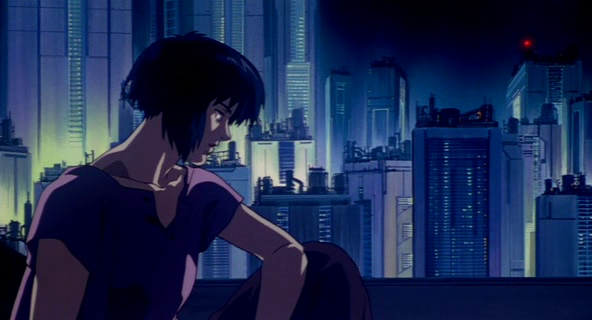
Ghost in the Shell is a classic 2D animation rich in great visuals. There are lots of marvellous sequences like, for example, Major’s rooftop drop, chase after a bogus thug, or the final fight against Tachikoma. Even the scenes of Kusanagi roaming through the futuristic city were spot on. One can clearly see that Oshii was going for “the feels” in this film rather than proper story-telling. It is a shame though that these sequences were “re-enacted” in the horrendous 2017 live-action adaptation.
 
The similarities to Blade Runner (1982) are striking and, as Oshii said himself, no cyberpunk buff can fully escape the influence of this one movie. However, Ghost in the Shell manages to give a fresh perspective on the theme of humanity consumed by cybernetics. Slow pace and subtle philosophical undertones add a whole new layer of interpretation, but they also render the film’s second act as completely forgettable. It is quite hard for me to actually recall every time after I watched it what exactly happened in the middle of the film. It is like Oshii performed a Jedi mind trick on me, which is the film’s only disadvantage.
The production team behind the animation actually combined classic frame-by-frame drawing with digital compositing effects and CGI. Surprisingly, the whole film was actually scanned in order to be digitally edited later on. Evidently, apart from the hectic work of the animators, the praise goes to Kenji Kawaii for composing the legendary music score which defined the world of Ghost in the Shell.
 
Recommendations
If you have not yet seen Ghost in the Shell, then do not wait any longer and check it out. Additionally, the film serves as a decent introduction into the franchise (Ghost in the Shell 2: Innocence (2004), Ghost in the Shell: Stand Alone Complex (2002-2005), Ghost in the Shell: Arise (2013-2015)…) It is a great animation which stands out with its overload of visual aesthetics even today. I find myself fondly coming back to it every now and them. Maybe it is a whisper from my ghost which tells me to do that…
Overall score: 8/10