The Wailing (2016) [Film Review]

The Wailing; or, Something Wicked This Way Comes
     It wasn't just one or two people. He took pictures of them when they were alive and then went back for more when they went crazy and died.
The Wailing is a South Korean supernatural/mystery horror directed by Na Hong Jin (The Chaser (2008)). The year it was released, it gained both critical and commercial success as well as lots of awards at many film festivals. I remember being vaguely aware of the movie back in 2016, but it was this year when I finally had the time to sit down and calmly check it out. Needless to say, The Wailing blew me away with its gripping plot and unconventional storytelling.
Release Info
Directed by: Na Hong Jin Starring: Kwak Do Won, Kim Hwan Hee, Jun Kunimura, Chun Woo Hee
Language: Korean Original Title: 곡성 Runtime: 156 min
 
Synopsis
Jong Goo (Kwak Do Won) is a local police officer who investigates a series of brutal murders in his village. The perpetrators had a rash and behaved in a very violent manner only to fall into a stupor and die after committing a murder. Jong Goo’s investigation leads him to believe in rumours about the Japanese stranger living in the mountains (Jun Kunimura) who is responsible for the spread of an unknown disease. John Goo starts having dreams about the stranger and, soon after, his daughter, Hyo Jin (Kim Hwan Hee), falls ill. Desperate to cure Hyo Jin, John Goo succumbs to the gossip and confronts the Japanese stranger. In consequence, a series of supernatural events ensues which make the police officer doubt who to trust and who to fight.
 
The Exorcist 2.0
I have to say this out front: The Wailing is the best horror film I have seen in the last ten years. I know that giving it a label of pure “horror” may be debatable, but that was my primary impression after spending two hours and a half watching a village that descends into primal frenzy.
 
The greatest advantage of the film is its ambiguity. There are subtle moments, grand sequences, and bold playing with the language of film itself that made me think about David Lynch’s Lost Highway (1997) or Christopher Nolan’s Memento (2000). After watching the film, my mind was crammed with multiple theories about what really happened in the story. Did everyone go crazy because of bad mushrooms? Maybe there were some supernatural forces working behind the scenes? Suffice to say, I am not the only viewer with similar thoughts. The film is deconstructed again and again by its many fans.
 
Director Na Hong Jin allegedly devoted the whole 6 years for the production of this movie. To be honest, the meticulousness of his endeavour is clearly visible on the screen. Apart from playing with conventions, we get to see some folktale stuff as well as references to Buddhism and Christianity. The further the story goes, the more gripping it becomes, which only made me regret that I checked it out just now. What is more, the final climax… OMG (no spoilers), it left me absolutely gobsmacked.
 
With regard to performances, Kwak Do Won does a very good job as a clumsy cop/loving father lost in a maze of vagueness and ambivalence. Kim Hwan Hee is wonderful as a daughter in distress. Long have I waited and now I saw such a professional child actor. Nevertheless, the ultimate praise goes to Jun Kunimura for his supporting part. Seriously, he should have won an Oscar for his performance!
 
Recommendations
If you have not seen The Wailing yet, do not repeat my mistake and watch it now. As I said already, it is a beautifully crafted film that sent chills down my spine. I would go as far as to say that it eats the classic William Friedkin’s The Exorcist (1973) on breakfast. The Wailing is in a league of its own. By the way, be extra careful when somebody wants to take a picture of you!
Overall score: 8/10

Ghost in the Shell (1995) [Anime Review]

Ghost in the Shell; or, Whispers of the Soul
     Just as there are many parts needed to make a human a human, there’s a remarkable number of things needed to make an individual what they are. A face to distinguish yourself from others. A voice you aren't aware of yourself. The hand you see when you awaken. The memories of childhood, the feelings for the future. That’s not all. There’s the expanse of the data net my cyber-brain can access. All of that goes into making me what I am. Giving rise to a consciousness that I call “me.”
There are not many anime features that are widely recognised and appreciated when their titles are uttered. For instance, we can enumerate such films as Akira (1988), Perfect Blue (1998), and Spirited Away (2001), all being the icons of Japanese animation in their own right. However, Ghost in the Shell, a 1995 production directed by Mamoru Oshii and based on the manga by Masamune Shirow, is also a part of this “hall of fame”. It is a philosophical tale about cyborgs in pursuit of self-identity in the age driven by technology.
Release Info
Directed by: Mamoru Oshii Voice actors: Atsuko Tanaka, Akio Otsuka, Tamio Oki, Iemasa Kayumi
Language: Japanese Original Title: 攻殻機動隊 Runtime: 82 min
Synopsis
It is the year 2029. Thanks to technological advancements, a human body (and even its brain) can now be fixed by cybernetic parts. The only differentiating factor between people and mindless cyborgs is the possession of a “ghost” (consciousness) within cybernetic shells. Major Motoko Kusanagi is an assault-team leader of Section 9, a group dealing with Public Security issues. The team stumbles upon a case when the Foreign Minister’s translator is ghost-hacked by the elusive international terrorist known as the Puppet Master. Section 9 begins the hunt after the Puppet Master in the course of which they discover a top-secret government conspiracy.
 
“For now we see through a glass, darkly.”
I became aware of the Ghost in the Shell franchise in the late 2000s when someone told me that The Matrix (1999) is basically a rip-off of the original animation. Needless to say, I checked out the 1995 film on my own and found it to be much more entertaining as well as thought-provoking than the Hollywood’s sci-fi “reimagining,” so to say.
 
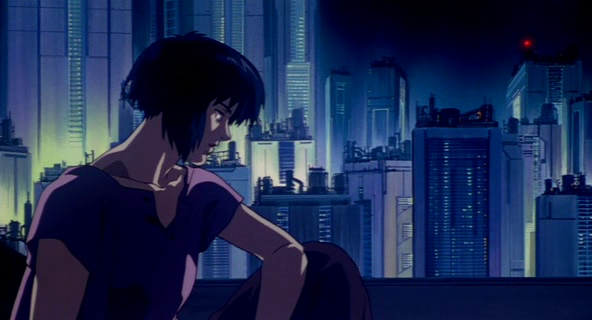
Ghost in the Shell is a classic 2D animation rich in great visuals. There are lots of marvellous sequences like, for example, Major’s rooftop drop, chase after a bogus thug, or the final fight against Tachikoma. Even the scenes of Kusanagi roaming through the futuristic city were spot on. One can clearly see that Oshii was going for “the feels” in this film rather than proper story-telling. It is a shame though that these sequences were “re-enacted” in the horrendous 2017 live-action adaptation.
 
The similarities to Blade Runner (1982) are striking and, as Oshii said himself, no cyberpunk buff can fully escape the influence of this one movie. However, Ghost in the Shell manages to give a fresh perspective on the theme of humanity consumed by cybernetics. Slow pace and subtle philosophical undertones add a whole new layer of interpretation, but they also render the film’s second act as completely forgettable. It is quite hard for me to actually recall every time after I watched it what exactly happened in the middle of the film. It is like Oshii performed a Jedi mind trick on me, which is the film’s only disadvantage.
The production team behind the animation actually combined classic frame-by-frame drawing with digital compositing effects and CGI. Surprisingly, the whole film was actually scanned in order to be digitally edited later on. Evidently, apart from the hectic work of the animators, the praise goes to Kenji Kawaii for composing the legendary music score which defined the world of Ghost in the Shell.
 
Recommendations
If you have not yet seen Ghost in the Shell, then do not wait any longer and check it out. Additionally, the film serves as a decent introduction into the franchise (Ghost in the Shell 2: Innocence (2004), Ghost in the Shell: Stand Alone Complex (2002-2005), Ghost in the Shell: Arise (2013-2015)…) It is a great animation which stands out with its overload of visual aesthetics even today. I find myself fondly coming back to it every now and them. Maybe it is a whisper from my ghost which tells me to do that…
Overall score: 8/10

Ring: Saishushou [Ring: The Final Chapter] (1999) [Drama Review]

Ring Saishushou; or, Race Against Time
     Why must you hate mankind? Even till now, there’s someone who loves you with all his heart. You didn’t expect it?
Right after the premiere of Hideo Nakata’s Ringu in 1998, the Ring craze took Japan by the storm. In spite of a sequel (more about it soon) released by Toho simultaneously with the original, FujiTV commissioned a TV drama. Ring: Saishushou, also known as Ring: The Final Chapter, is a 12-episode-long adaptation of Koji Suzuki’s famous novel. If counting the preceding films, Ring: Kanzenban and Ringu, then Ring: Saishushou is actually the third re-telling of the novel since its publication in 1991.
Release Info
Directed by: Fukumoto Yoshito, Hidetomo Matsuda, Yoshihito Fukumoto Starring: Toshiro Yanagiba, Tomoya Nagase, Kotomi Kyono, Hitomi Kuroki
Language: Japanese Original Title: リング ~最終章~ No. of eps: 12
 
Synopsis
Kazuyuki Asakawa (Toshiro Yanagiba) is a newspaper reporter who investigates the case of teenagers who died simultaneously in various places due to myocardial infarction. He arrives at a cabin in the countryside and finds the VHS tape which was viewed by the teenagers. The tape turns out to be… a music video by a pop idol Nao Matsuzaki. With the help of a specialist in paranormal phenomena, Ryuji Takayama (Tomoya Nagase), Asakawa discovers that the video contains a hidden, subliminal curse which causes people to die 13 days after watching it. Together with a fellow reporter, Akiko Yoshino (Kotomi Kyono), and a scientist, Reiko Miyashita (Hitomi Kuroki), Asakawa sets out on a search to find a person behind the curse…
 
Sadako Ain’t Letting It Go
As some other blogger rightfully stated in his review of the drama, each entry in the Ring franchise is bound to be compared with Hideo Nakata’s acclaimed work. It is understandable, in my opinion; however, every Ring adaptation should also be set against its original source material, Koji Suzuki’s novel. The drama only seemingly resembles the literary work in its first few episodes. For example, Asakawa is, indeed, a male reporter, but he is also a widower in this version who single-handedly raises a son. The tape is at first turned into a joke, with its true contents only to be revealed later. In addition, the curse’s time span is stretched so as to accommodate new characters and their subplots.
 
I don now want to get into the spoiler territory, so just let me say that the liberties this drama takes to change the story are not outrageous or particularly bad. In fact, they actually seem to work. I love the new take on the VHS tape and the search for Sadako in this series. We do get to know a lot of details about her life this time, and even some relatives pop up for a moment. Sadako herself (played brilliantly by Tae Kimura) does not do her iconic “coming out of a TV” gig, but she has a whole set of other haunting tricks (for instance, telepathic communication or materialising through a sink).
 
Unfortunately, it is obvious that this drama was made on a tight budget, so do not expect any spellbinding special effects. The only disadvantage that really struck me was an underworked music score which was painfully overused in the key scenes.
 
What I appreciated the most in this adaptation is that it really focused on an aspect from the novel that was conveniently omitted by the movies. Namely, a scientific explanation is implied behind Sadako’s curse. The VHS is merely a stimulant which initiates a virus in bodies of poor people who watch it. By the way, I was surprised to find out that Nao Matsuzaki is a real J-singer. Way to go with promoting your brand via Ring!
 
With regard to performances, Toshiro Yanagiba at first seems to be ardently working on material that was not written for him, but with each consecutive episode he begins to own the part (best confrontation-in-the-well scene in the franchise!). Tomoya Nagase is a worthy addition; however, he gets sidelined halfway through the series. Kotomi Kyono and Akiko Yada are a-okay as an annoying reporter and a distressed sister, respectively. A wonderful icing on the cake is Hitomi Kuroki as a scientist who tries to find a cure for the Ring Virus.
 
Recommendations
If you are as equally obsessed as me about checking out Ring adaptations, then Ring: Saishushou is the stuff for you. You can easily check it out on Youtube. I would not label the drama as scary, but it undoubtedly has the right atmosphere and a few very creepy moments. I’m really keen on watching FujiTV’s follow up to this series, which is Rasen (1999), the adaptation of Suzuki’s second Ring novel.
Overall score: 8/10